The growth trajectory of a domestic kitten (Felis catus) from birth to twelve months represents one of the most metabolically demanding phases in mammalian biology. Within the first five months of life, a kitten’s body mass increases exponentially, requiring an intense structural, neurological, and immunological architecture.
Because cats are obligate carnivores, their evolutionary blueprint dictates that this rapid cellular growth must be fueled almost exclusively by animal tissues. Unlike omnivores, a kitten’s metabolic pathways are permanently upregulated to process high levels of protein and fat while lacking the capacity to efficiently utilize complex carbohydrates.
This comprehensive, long-form manual provides a deep diagnostic analysis of premium, grain-free wet kitten formulas—using Wellness Complete Health Kitten Paté Chicken Entrée as our primary clinical case study. We will dissect macro and micronutrient frameworks on a dry-matter basis, analyze physiological development pathways, evaluate commercial purchasing structures, and outline exact feeding mechanics tailored to specific developmental milestones.
The Macro-Nutritional Architecture of Growth
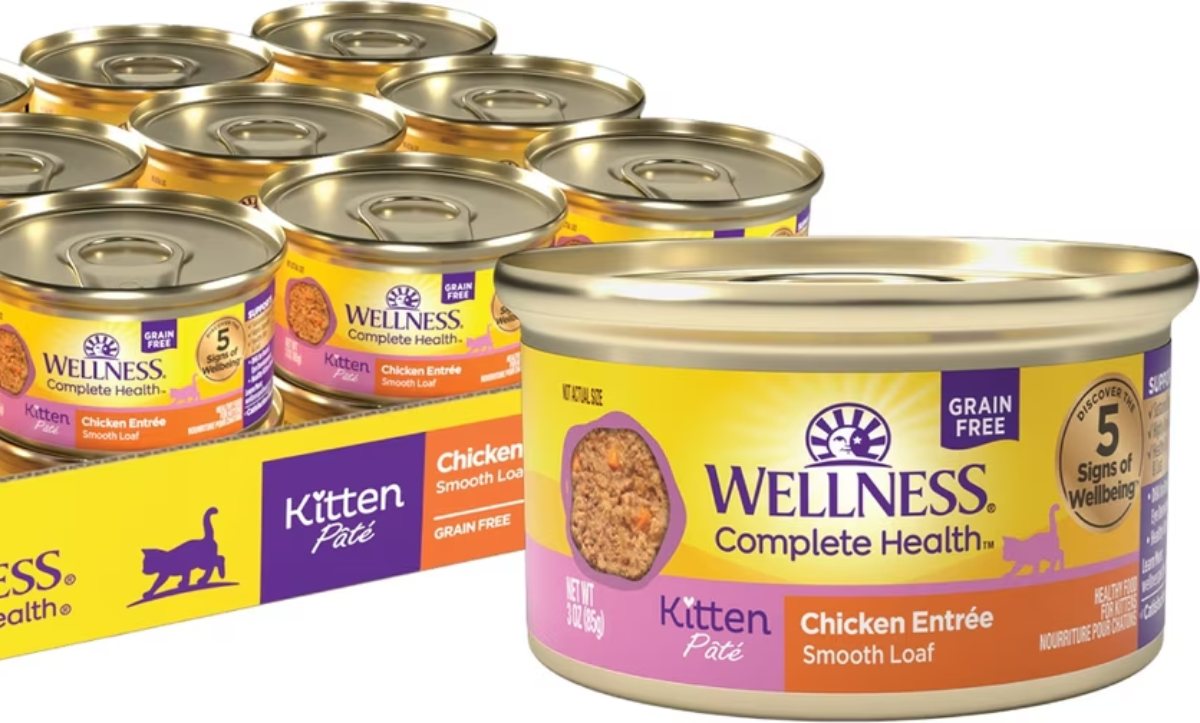
When evaluating a diet for a growing kitten, looking at the “Guaranteed Analysis” on the back of a can is fundamentally misleading. Wet food compositions contain high levels of moisture (typically 75–80%), which dilutes the raw percentage values of the nutrients listed. To understand the true biological value of the diet, the formulation must be evaluated on a Dry Matter (DM) Basis, removing water weight entirely.
                  [Wet Formulation: 78% Moisture]
                                 │
                                 ▼ (Water Removal)
                  [Dry Matter Substrate: 22%]
                                 │
        ┌────────────────────────┼────────────────────────┐
        ▼                        ▼                        ▼
Crude Protein: 50.0%       Crude Fat: 27.3%       Carbs & Ash: 13.6%
Using the metabolic baseline of the Wellness Complete Health Kitten formula ($100\% – 78\% \text{ Moisture} = 22\% \text{ Dry Matter}$), we find a highly specialized macronutrient distribution:
1. Structural Protein Dynamics (50.0% DM)
Kittens require an immense nitrogen balance to support skeletal muscle hypertrophy, organ development, and tissue accretion. A dry-matter protein profile of 50.0% ensures that the liver’s constant gluconeogenesis pathways are fully saturated without forcing the body to catabolize its own lean mass. The primary amino acid pool must contain high concentrations of lysine, arginine, and methionine to fuel cellular mitosis and structural protein synthesis.
2. High-Density Lipids and Fatty Acids (27.3% DM)
Fat is not merely an energy source for a kitten; it is the structural component of cell membranes and the primary driver of hormone synthesis. At 27.3% DM fat, this formulation provides the required caloric density ($1,361 \text{ kcal/kg}$) within a low-volume meal, preventing gastrointestinal stretching while meeting the high energy demands of a growing animal.
3. Carbohydrate Mitigation ($\approx$13.6% DM)
By eliminating grains, corn, wheat, and soy, the carbohydrate load is kept strictly within the ancestral biological threshold. This minimizes insulin spikes and protects the developing pancreas from the metabolic stress that frequently drives juvenile obesity and early-onset metabolic disorders.
Ingredient Breakdown & Biological Availability
The biological value ($BV$) of a protein source depends on its amino acid profile and how easily a cat’s short, specialized gastrointestinal tract can digest it. This wet kitten formula relies on a highly bioavailable animal matrix:
-
Muscle Tissues (Chicken): Provides the foundational structural protein base, rich in essential branch-chain amino acids (leucine, isoleucine, and valine).
-
Secretory Organs (Chicken Liver & Chicken Hearts): Organ meats are nutrient-dense powerhouses. Liver delivers pre-formed Vitamin A (retinol), iron, and B-vitamins directly, bypassing the need for synthetic conversion. Hearts provide a highly concentrated, natural source of Taurine and L-Carnitine, which are critical for cardiac myofibril contractility and systemic fatty acid transport.
-
Moisture Delivery (Chicken Broth): Rather than using plain water, the inclusion of animal broth ensures the retention of water-soluble proteins and trace minerals, while maintaining a rich aroma profile to stimulate the kitten’s highly olfactory appetite drive.
Micronutrient Enrichment and Developmental Pathways
Beyond macronutrients, the transition from a mother’s milk to solid food requires targeted micronutrient support to ensure proper development of the neurological, skeletal, and visual systems.
                            [Targeted Micronutrient Fueling]
                                           │
         ┌─────────────────────────────────┼─────────────────────────────────┐
         ▼                                 ▼                                 ▼
   [Neuro-Retinal]                     [Skeletal]                     [Immunological]
  DHA/EPA (0.04% min)             Calcium (0.3%) : Phos (0.25%)         Vitamin E & Beta-Carotene
  Taurine (0.1% min)              (Structural Mineralization)          (Antioxidant Defense Matrix)
1. The Neuro-Retinal Pathway (DHA & Taurine)
The brain and retina experience rapid growth during the first six months of a kitten’s life.
-
DHA (Docosahexaenoic Acid): This formulation guarantees a minimum of 0.04% EPA + DHA derived directly from marine fish oil. DHA is a primary structural fatty acid in the central nervous system and retina, clinically proven to enhance cognitive development, trainability, and visual acuity in young felines.
-
Taurine (0.1% min): Cats cannot synthesize taurine from precursor amino acids like cysteine. A deficiency during growth quickly leads to central retinal degeneration and dilated cardiomyopathy. Direct supplementation via organ tissues and pure taurine guarantees optimal development of cardiac muscle cells and photoreceptors.
2. The Skeletal Mineralization Matrix (Calcium to Phosphorus Ratio)
Uncontrolled mineral levels in growth formulas can cause severe metabolic bone diseases, such as nutritional secondary hyperparathyroidism.
-
Calcium (0.3% min) and Phosphorus (0.25% min): This yields a highly precise 1.2:1 Calcium-to-Phosphorus ratio. This exact proportional balance is required for osteoblast activity, ensuring rapid bone mineralization and healthy tooth eruption without causing calcification of soft tissues.
3. Immunological Defense (Antioxidants and Prebiotics)
As a kitten transitions away from maternal antibodies, they enter an “immunity gap” where their immune system is highly vulnerable.
-
Antioxidant Support: Enriched with Vitamin E (100 IU/kg min) and Beta-Carotene to neutralize free radicals and optimize cellular immune responses during vaccination schedules.
-
Gastrointestinal Biome: The inclusion of Dried Chicory Root provides a natural source of inulin, a prebiotic fiber that feeds beneficial gut bacteria (Lactobacillus and Bifidobacterium), stabilizing the delicate juvenile microbiome against opportunistic pathogens.
Milestone-Based Feeding Mechanics
Kittens possess tiny stomach capacities paired with exceptionally high metabolic burn rates. To prevent hypoglycemia and digestive distress, feeding schedules must evolve alongside their physical development.
Phase 1: Early Growth (Weaning to 20 Weeks)
-
Metabolic Status: Hyper-growth phase. Satiety signals are still developing, and energy demands are at their lifetime peak.
-
Feeding Protocol: Ad libitum access or 3 to 4 tightly controlled meals per day. Feed the kitten as much as they will consume in a single sitting to ensure maximum caloric intake during this critical phase.
Phase 2: Intermediate Consolidation (21 to 30 Weeks)
-
Metabolic Status: Growth slows slightly; skeletal structure elongates.
-
Feeding Protocol: Transition to $\approx \frac{2}{3}$ can per pound of body weight per day, divided into 3 distinct meals. This manages caloric intake to prevent early fat deposition while supporting continuous lean tissue growth.
Phase 3: Maturation Phase (31 to 52 Weeks)
-
Metabolic Status: Stabilization phase. Hormonal shifts (especially post-sterilization/neutering) reduce baseline energy expenditure by up to 30%.
-
Feeding Protocol: Reduce intake to $\approx \frac{1}{2}$ can per pound of body weight per day, divided into 2 principal meals.
Mixed Feeding Optimization
If integrating dry kibble into your routine, maintain strict caloric boundaries to prevent obesity:
Procurement Architecture and Financial Optimization
Sustaining a premium, high-moisture diet requires an understanding of procurement economics. Utilizing institutional pet distribution networks like Chewy provides distinct financial advantages across different purchasing strategies:
Financial Efficiency Matrix (3-oz Can, Case of 24 Baseline)
| Purchasing Tier | Total Cost Per Case | Calculated Cost Per Ounce | Unit Cost Per Can (116 kcal) | Economic Assessment |
| First-Time Autoship Promotion | $28.39 | $0.39 / oz | $1.18 / can | Maximum procurement efficiency (35% capital conservation up to $20). |
| Standard Recurring Autoship | $41.50 | $0.57 / oz | $1.72 / can | Sustained operational value (5% marginal discount on future orders). |
| Standard One-Time Purchase | $43.68 | $0.61 / oz | $1.82 / can | Standard retail baseline; lowest long-term capital efficiency. |
Clinical Transition Protocol
To prevent acute gastrointestinal distress, vomiting, or osmotic diarrhea caused by sudden enzymatic changes, transition your kitten using a calculated 7-day programmatic titration:
[Day 1-2] ──► 75% Legacy Food + 25% Wellness Canned
[Day 3-4] ──► 50% Legacy Food + 50% Wellness Canned
[Day 5-6] ──► 25% Legacy Food + 75% Wellness Canned
[Day 7+]  ──► 100% Wellness Complete Health Kitten Paté
By respecting this gradual adaptation phase, your kitten’s digestive tract can efficiently adjust its enzyme production to match the rich, highly concentrated nutrient profile of their new diet—setting a solid foundation for lifelong health and vitality.
FAQ
1. What is the best wet food for kittens?
The best wet food for kittens is a complete and balanced formula specifically designed for growth. It should contain high-quality animal protein, adequate fat levels, taurine, DHA, essential vitamins, and minerals that support healthy development during the first year of life.
2. Why do kittens need different food than adult cats?
Kittens grow rapidly and require significantly more calories, protein, fat, and specific nutrients than adult cats. Their diets are formulated to support muscle development, bone growth, immune function, and neurological development.
3. Is wet food better for kittens than dry food?
Wet food offers several benefits, including increased moisture intake, improved hydration, easier digestion, and often a higher proportion of animal-based protein. Many veterinarians recommend incorporating wet food into a kitten’s diet for optimal hydration and urinary health.
4. How much protein should kitten food contain?
Kitten food should provide a high level of animal-based protein to support rapid growth and development. High-protein formulas help build muscle, maintain healthy organs, and provide essential amino acids required for lifelong health.
5. Why is taurine important for kittens?
Taurine is an essential amino acid that supports heart function, vision, nervous system development, and overall growth. Cats cannot produce sufficient taurine on their own, making dietary supplementation critical.
6. What role does DHA play in kitten development?
DHA (Docosahexaenoic Acid) is an omega-3 fatty acid that supports brain development, cognitive function, learning ability, and visual health during the early stages of growth.
7. Is grain-free kitten food healthier?
Grain-free kitten food can be beneficial when it emphasizes high-quality animal proteins and limits unnecessary carbohydrates. However, ingredient quality and nutritional balance are more important than whether a food contains grains.
8. How often should kittens be fed?
Young kittens generally require three to four meals per day due to their small stomachs and high energy demands. As they mature, feeding frequency can gradually decrease to two or three meals daily.
9. What ingredients should I look for in kitten food?
Look for named animal proteins such as chicken, turkey, salmon, or beef as primary ingredients. Nutrient-rich organ meats, fish oil, taurine, vitamins, and balanced minerals are also important components.
10. Why are organ meats included in kitten food?
Organ meats such as liver and heart provide highly bioavailable nutrients including vitamin A, iron, taurine, B vitamins, and essential fatty acids that support healthy growth and development.
11. Can kittens eat adult cat food?
Adult cat food is not ideal for growing kittens because it may not provide sufficient calories, protein, fat, and nutrients required during developmental stages. Kitten-specific diets are recommended until approximately one year of age.
12. What is the ideal calcium-to-phosphorus ratio for kittens?
A balanced calcium-to-phosphorus ratio is essential for proper bone and tooth development. Proper mineral balance helps prevent skeletal abnormalities and supports healthy growth.
13. How do I transition my kitten to a new food?
Gradually introduce the new food over seven to ten days by slowly increasing the proportion of the new diet while decreasing the old one. This helps minimize digestive upset and improves acceptance.
14. Why is moisture important in kitten diets?
Adequate moisture supports hydration, kidney health, urinary tract function, and digestion. Wet food naturally provides significantly more water than dry kibble.
15. Can kitten food help support immune health?
Yes. Many premium kitten foods contain antioxidants, vitamins, minerals, and prebiotics that help support immune system development during the vulnerable transition away from maternal antibodies.
16. What are prebiotics in kitten food?
Prebiotics are specialized fibers that support beneficial gut bacteria. A healthy digestive microbiome can improve nutrient absorption, digestion, and immune system function.
17. How many calories does a growing kitten need?
Caloric requirements vary based on age, breed, activity level, and growth rate. Kittens generally require significantly more calories per pound of body weight than adult cats due to rapid development.
18. Should I mix wet and dry food for my kitten?
A combination of wet and dry food can provide variety, hydration benefits, and feeding flexibility. Portion control is important to avoid excessive calorie intake.
19. When should I switch from kitten food to adult cat food?
Most cats can transition to adult food around 12 months of age, although larger breeds may benefit from kitten diets for a longer period depending on their growth patterns.
20. What is the biggest nutritional mistake kitten owners make?
One common mistake is choosing food based solely on marketing claims rather than evaluating ingredient quality, nutritional balance, protein sources, and suitability for growth and development.