The "Single Kitten Syndrome" Myth vs. Reality: Why Science Rejects the Label but Embraces the Logic
2 months ago
If you have stepped foot inside an animal shelter, scrolled through a foster rescue page, or browsed a feline community forum recently, you have likely run into a strict, almost unyielding rule: Kittens under 12 weeks old must be adopted in pairs.
The driving force behind this modern adoption policy is a collection of behavioral quirks known as "Single Kitten Syndrome" (sometimes called "Tarzan Syndrome"). The term paints a dramatic picture. It suggests that a lone kitten, deprived of a sibling playmate, is essentially doomed to a life of chronic boredom, high anxiety, destructive scratching, and outright aggression toward human hands.
But is Single Kitten Syndrome a medically proven condition, or is it a clever behavioral label designed to encourage double adoptions?
When we look past the shelter catchphrases and dive into feline evolutionary biology, early socialization windows, and recent veterinary studies, a far more nuanced picture emerges. While raising a solo kitten presents distinct training challenges, labeling an individual animal rarely solves a behavioral issue.
This masterclass deconstructs the science behind the solo kitten, explores the real mechanics of sibling development, and provides a comprehensive guide to raising a well-socialized, resilient cat on your own terms.
Deconstructing the Science Is Single Kitten Syndrome Real?
To understand how to best raise a young cat, we must first separate cultural consensus within the rescue community from empirical scientific data.
                           [ The Feline Behavioral Matrix ]
                                          │
         ┌────────────────────────────────┴────────────────────────────────┐
         ▼                                                                 ▼
   [ Shared Anecdotes ]                                          [ Empirical Science ]
   ├── Widespread rescue policy mandates                          ├── Zero statistical data backing "Syndrome"
   ├── Fear of biting/scratching habits                           ├── Aggression tied to home/owner methods
   └── Observed differences in hand-reared solos                  └── Acknowledges massive individual variations
1. What the Scientific Community Says
From a strictly peer-reviewed, scientific standpoint, there is zero empirical evidence to support the existence of Single Kitten Syndrome.
Feline behaviorists and researchers view cats as highly individual creatures. Applying a blanket "syndrome" label fails to account for a cat's unique genetic baseline and lived experiences. In fact, a recent behavioral study focused on feline aggression looked directly at early social exposure—comparing bottle-reared kittens, early rehomed kittens, and true singletons.
The conclusion? The study found no direct link between early isolation from siblings and long-term aggression.
Instead, the researchers concluded that the vast majority of an adult cat's behavioral outcomes are driven by a combination of three distinct variables:
-
The Cat’s Baseline Personality: Inherent genetic traits that dictate whether a cat is naturally bold, timid, social, or independent.
-
The Home Environment: The presence of structural stability, quiet resting areas, and routine environmental enrichment.
-
The Owner’s Training Methodology: The explicit reinforcement mechanics and socialization steps applied during the first year of life.
2. What Is "Littermate Syndrome"?
In the canine world, behaviorists document a true condition known as littermate syndrome. This occurs when two puppies from the same litter form an intense, codependent bond with each other. This extreme bond can lead to severe panic, separation anxiety, and a complete failure to bond with humans if the puppies are separated.
Fortunately, littermate syndrome does not happen in felines. While sibling cats can form beautiful, tight friendships, their evolutionary biology as solitary, territorial hunters prevents them from developing this type of codependent social panic.
3. The Truth Behind Hand-Reared Singletons
If science rejects the "syndrome" label, why do countless foster carers, shelters, and cat sitters observe distinct behavioral issues in solo cats? The answer is often rooted in how the solo kitten was raised.
There is a massive behavioral gap between a single kitten raised by a human bottle-feeder and a kitten raised by a mother cat (the queen). Kittens that are hand-reared entirely on their own miss out on two layers of essential education: maternal correction and sibling feedback.
Data shows that single, hand-reared kittens frequently struggle to read normal feline body language as adults. They often don't know when to stop a game, cannot grasp when another pet wants to be left alone, and are highly prone to over-stimulating during normal handling.
The Sibling Classroom How Kittens Teach Each Other Lifelong Skills
To understand why a solo kitten might develop rough habits, we have to look at what happens inside a normal litter between 4 and 12 weeks of age. During this critical development window, a litter of kittens acts as a highly specialized, 24-hour behavioral classroom.
                        [ The Sibling Play Matrix ]
                                     │
        ┌────────────────────────────┴────────────────────────────┐
        ▼                                                         ▼
 [ Agonistic/Combat Play ]                                 [ Predatory Coordination ]
 ├── Wrestling, chasing, and pouncing                      ├── Watching the Queen hunt prey
 ├── Instant feedback on bite force                         ├── Eye-paw physical tracking
 └── Learning boundaries of physical strength               └── Mirroring micro-movements of siblings
1. The Mechanics of Bite Inhibition
When kittens roll around, chase, and swat at one another, they are engaging in what behaviorists call agonistic play. This mock-combat serves a crucial purpose: it teaches bite inhibition.
If a kitten lets their guard down and bites a sibling too hard during a wrestling match, the response is immediate. The bitten sibling will let out a sharp cry, bite back with equal force, or completely walk away from the game.
This instant feedback loop teaches the biting kitten a clear lesson: My teeth are sharp. If I use too much force, the fun stops and I get hurt.
2. Predatory Development and Eye-Paw Coordination
Littermates also hone their hunting instincts together. By watching their mother track moving objects and by pouncing on each other's twitching tails, kittens develop their eye-paw coordination. They learn to gauge speed, calculate distance, and control their body movements based on the immediate feedback of a live, moving sibling.
3. The Problem with Human Substitution
When a kitten grows up without siblings, they still have those same intense predatory drives, but they lack a feline classmate. Naturally, they turn their sights on the only moving objects available in their new environment: human hands, wrists, and ankles.
Here is where the breakdown occurs. A human cannot replicate the boundary-setting of a sibling kitten. If you yell, pull your hand away quickly, or scold a kitten when they bite your fingers, the kitten often misinterprets your reaction. They view your quick movements as exciting prey behavior or see your scolding as a stressful threat.
Because humans cannot speak "kitten," solitary young cats are often much slower to learn appropriate physical boundaries.
The Myth of the Lifelong Sibling Bond
Many adopters bring home two kittens from the same litter under the assumption that they are securing a lifelong friendship. While adopting littermates is highly recommended for busy households, it is important to understand that nature offers no permanent guarantees.
[ Early Kittenhood (0-12 Months) ] ──► Deeply Connected, Shared Sleep, Mutual Grooming
[ Social Maturity (2-4 Years) ]    ──► Hormonal Overhauls ──► Potential to Drift Apart or Turn Aggressive
Felines undergo a profound behavioral and hormonal shift when they reach social maturity between 2 and 4 years of age. As their adult personalities settle in, related cats can easily grow apart. Their tolerance levels for sharing territory can shift dramatically.
It is entirely common for once-inseparable sibling kittens to become indifferent to each other as adults—or, in some cases, to develop severe territorial aggression that requires permanent separation.
At their core, cats are individualists. Some crave constant feline company, while others are biologically hardwired to prefer an independent, solo lifestyle.
The 6-Step Socialization Blueprint for Solo Kittens
If you choose to adopt a single kitten—or if you have a full-time lifestyle where a single pet fits best—you must intentionally step into the role of primary educator.
The primary socialization window for felines is short, peaking between 2 and 7 weeks of age, but their learning curve extends well into their fourth month. To prevent fear, anxiety, and behavioral issues, you can follow this structured 6-step socialization continuum.
                    [ The Solo Kitten Socialization Continuum ]
                                        │
         ┌──────────────────────────────┼──────────────────────────────┐
         ▼                              ▼                              ▼
 [ Touch Association ]        [ Stranger Desensitization ]    [ Social Referencing ]
 ├── Volitional interaction   ├── Varied age, sex, and sizes  ├── Texture & shape variation
 └── Counterconditioning      └── End on a rewards-basis      └── Acoustic ambient acclimation
Step 1: Associate Handling with Positive Consequences
To prevent fear-motivated aggression as your cat grows, you must teach your kitten that human touch is always safe and rewarding.
-
The Volitional Approach: Avoid reaching down to abruptly scoop up a resting kitten. Instead, extend a hand at their eye level and allow them to make the choice to approach you.
-
Active Counterconditioning: If your kitten shows body tension or resists being handled, implement a daily counterconditioning program. Gently touch a sensitive area—such as a paw, ear, or their belly—for one second, and instantly reward them with a high-value treat. This builds a positive association that makes future vet visits and claw trimmings stress-free.
Step 2: Encourage Positive Interactions with Strangers
An isolated kitten can easily grow into a terrified adult cat that flees the room whenever the doorbell rings.
-
Introduce your kitten to a wide variety of people of different ages, sexes, voices, and sizes.
-
Instruct guests to sit low on the floor, offer savory treats, or use a wand toy to build confidence. Always keep these handling sessions brief and end them on a high note so the kitten remembers the experience fondly.
Step 3: Introduce Novel Objects via 'Social Referencing'
Build a resilient, confident cat by safely expanding their physical boundaries through new sensory experiences.
-
Provide a variety of safe floor textures for your kitten to walk on, such as crinkly packing paper, smooth tile, cardboard, and low-pile rugs.
-
Introduce uniquely shaped, safe household objects (like an open umbrella, a plastic laundry basket, or a yoga mat) into their play space, allowing them to investigate new shapes at their own pace.
Step 4: Habituate Your Kitten to Common Household Noises
Sudden sounds can easily startle a young animal. You can use their sense of hearing to help them get used to the normal sounds of a busy home.
-
Play recorded tracks of common household noises—such as a vacuum cleaner, a hairdryer, a doorbell, or pots clanging—at an incredibly low volume while your kitten is eating a meal or playing.
-
Over several weeks, slowly increase the volume of these tracks. As long as your kitten's body language stays relaxed, they will learn to tune out these normal everyday sounds.
Step 5: Safely Familiarize the Kitten with Other Future Pets
If your kitten might live with other animal species later in life, introduce them to those animals early and with close supervision.
-
Scent Swapping: Rub a small towel over a friendly, calm neighborhood dog, a rabbit, or a bird, and place that cloth directly into your kitten's environment to let them get used to the scent safely.
-
Controlled Visual Distance: Introduce a calm, friendly dog from a distance while the dog is securely on a harness and leash in a resting position. Keep the interaction calm, reward your kitten for staying relaxed, and slowly reduce the distance over multiple separate sessions.
[ Active Scent Exchange ] ──► [ Fixed Distance Visuals ] ──► [ Monitored Close Contact ]
Step 6: Teach the Hard Boundary of Polite Play
This is the single most important rule for successfully raising a solo kitten: Your bare hands and feet are never toys. While it may feel harmless to let a 2-pound kitten chase your moving fingers under a blanket, you are inadvertently reinforcing a behavioral habit that will become painful once they grow into a powerful adult cat with sharp teeth and claws.
                           [ Play Target Redirection ]
                                        │
         ┌──────────────────────────────┴──────────────────────────────┐
         ▼                                                             ▼
   [ Banned Targets ]                                           [ Approved Targets ]
   ├── Bare human fingers                                       ├── Long fishing-pole wands
   ├── Moving bare wrists                                       ├── Lightweight ping pong balls
   └── Unprotected moving ankles                                └── Loose catnip mice
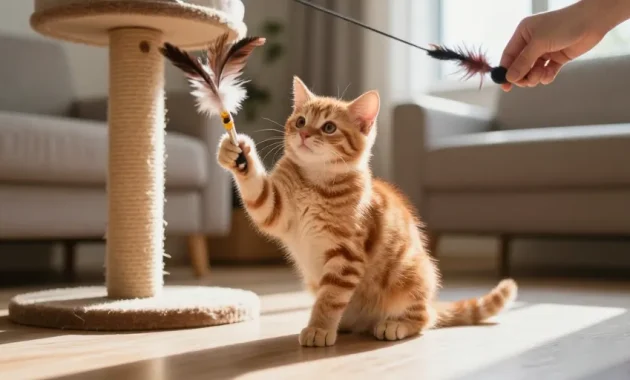
From day one, keep an interactive toy between your skin and your kitten's teeth. Direct their high-energy play toward long fishing-pole wands, loose catnip mice, or rolling ping-pong balls. If a kitten accidentally targets your skin during play, immediately freeze your movement, gently disengage, and redirect their attention to an inanimate toy. This ensures they associate human touch purely with calm affection and rewards.
Structural Comparison: Single Kitten vs. Sibling Pair Adoption
To help you decide which path fits your home best, this overview compares the practical, financial, and behavioral realities of both choices:
| Development Domain | Raising a Single Solo Kitten | Adopting a Bonded Sibling Pair |
| Primary Social Educator | The human owner must intentionally provide all socialization exercises. | The kittens naturally educate each other through constant play. |
| Bite Inhibition Training | Demands absolute consistency and quick redirection away from human skin. | Learned naturally within the litter via instant play-combat feedback. |
| Daily Exercise Mechanics | Requires multiple dedicated, manual play sessions with the owner each day. | The kittens burn energy together through self-directed play. |
| Separation Stress Risk | Higher risk of boredom or distress if left alone for long workdays. | Lower risk of separation anxiety; they provide comfort to each other. |
| Ecosystem Cost Profile | Baseline expenditures for veterinary care, food, and litter. | Double the long-term veterinary care, food, insurance, and medical costs. |
| Adult Compatibility | Becomes a highly human-focused, independent solo pet. | May stay close friends or naturally grow apart after reaching social maturity. |
Final Thoughts: Every Kitten Is a Custom Case
In the world of animal behavior, rigid labels and rules rarely tell the whole story. Animal organizations and pet professionals have a responsibility to place every animal in an environment that respects their genetics, early life experiences, and individual temperament.
Single Kitten Syndrome is not a scientifically proven diagnosis. You do not have to worry that adopting a lone kitten will automatically guarantee a lonely or poorly behaved cat.
If your home environment and financial budget are best suited for a single pet, you can move forward with confidence. By committing to rich environmental design, structured interactive play, and consistent boundaries, you can easily guide a solo kitten into a confident, peaceful, and well-adjusted companion for years to come.
FAQ — Single Kitten Syndrome and Solo Kitten Care
1. What is Single Kitten Syndrome?
Single Kitten Syndrome is a behavioral term used to describe certain habits sometimes seen in kittens raised without littermates, such as rough play, biting, excessive energy, or attention-seeking behaviors. However, it is not an officially recognized medical or scientific diagnosis.
2. Is Single Kitten Syndrome scientifically proven?
No. Current scientific research has not found definitive evidence proving that raising a single kitten automatically causes aggression or behavioral problems. Personality, environment, and training play a much larger role in shaping adult cat behavior.
3. Is it bad to adopt only one kitten?
Not necessarily. Many solo kittens grow into calm, affectionate, and well-adjusted adult cats when they receive proper socialization, enrichment, and structured play from their owners.
4. Why do shelters often require kittens to be adopted in pairs?
Many shelters encourage pair adoption because kittens naturally teach each other:
- Bite inhibition
- Play boundaries
- Social communication
- Energy release through play
Pair adoption can also reduce boredom in busy households.
5. Do single kittens become aggressive?
A single kitten is not automatically aggressive. However, solo kittens may take longer to learn appropriate play behavior if owners accidentally encourage rough play with hands or feet.
6. What causes biting behavior in solo kittens?
Kittens naturally explore the world through play and hunting instincts. Without littermates, they may target:
- Fingers
- Ankles
- Hands
- Moving feet
Consistent redirection to toys helps teach proper boundaries.
7. Can humans replace sibling socialization?
Humans cannot fully replicate kitten-to-kitten learning, but owners can successfully raise a healthy solo kitten through:
- Interactive play
- Positive reinforcement
- Environmental enrichment
- Early socialization exercises
8. How do kittens learn bite inhibition?
In a litter, kittens learn bite control through feedback from siblings. If one kitten bites too hard, the other kitten reacts immediately by crying out, stopping play, or biting back.
9. What are the best toys for solo kittens?
Good solo kitten toys include:
- Wand toys
- Feather teasers
- Catnip mice
- Ping pong balls
- Puzzle feeders
- Climbing towers
Interactive toys help burn energy safely.
10. Should I let my kitten play with my hands?
No. Allowing kittens to attack hands or feet teaches them that human skin is an acceptable target. Always redirect biting or scratching toward toys instead.
11. At what age is kitten socialization most important?
The primary kitten socialization window occurs between:
- 2 to 7 weeks of age
However, social learning continues throughout the first several months of life.
12. Can solo kittens live happily without another cat?
Yes. Many cats naturally prefer independent living and thrive as solo pets, especially when their environment includes:
- Daily interaction
- Enrichment
- Scratching areas
- Vertical climbing spaces
- Structured play sessions
13. Will sibling kittens always stay bonded?
Not always. Some sibling cats remain close for life, while others become more independent or territorial as adults. Feline relationships can change significantly after social maturity.
14. How can I prevent boredom in a solo kitten?
You can prevent boredom by providing:
- Scheduled playtime
- Rotating toys
- Window perches
- Climbing trees
- Puzzle feeders
- Training sessions
- Exploration opportunities
15. Are bottle-raised kittens more likely to have behavioral issues?
Bottle-raised kittens may require extra socialization because they miss some maternal correction and sibling interaction. However, with proper training and enrichment, they can still become excellent companions.
16. How much playtime does a solo kitten need daily?
Most kittens need multiple short play sessions throughout the day, usually totaling:
- 1–2 hours of active engagement daily
Highly energetic breeds may require even more stimulation.
17. What are signs of poor socialization in kittens?
Possible signs include:
- Fear of strangers
- Excessive hiding
- Rough biting
- Overstimulation
- Destructive scratching
- Anxiety around noises or new objects
Early socialization helps reduce these issues.
18. Is adopting two kittens easier than one?
In some cases, yes. Two kittens can:
- Entertain each other
- Burn energy together
- Learn social boundaries naturally
However, pair adoption also doubles:
- Food costs
- Veterinary bills
- Litter expenses
- Long-term care responsibilities
19. Can adult cats accept a solo kitten later?
Many adult cats can successfully accept a kitten if introductions are handled slowly and carefully using scent swapping and controlled meetings.
20. What is the most important rule when raising a solo kitten?
The most important rule is consistency:
- Never encourage rough play with human skin
- Provide structured daily play
- Use positive reinforcement
- Build confidence gradually
With patience and proper socialization, solo kittens can grow into calm, friendly, and emotionally balanced adult cats.