
Why Do Cats Bite Each Other's Necks? The Complete Guide to Feline Neck-Biting Behavior
3 weeks ago

You're watching your two cats interact, and things seem normal enough until one of them grabs the other by the back of the neck and holds on. The cat being held goes still, or squirms, or makes a sound you haven't heard before. Your instinct says this is aggression. Your brain isn't sure. You move toward them, not quite sure whether to intervene.
This moment — frozen between "should I stop this?" and "am I overreacting?" — is one of the most common confusing experiences in multi-cat households, and it happens because neck biting is a genuinely multi-purpose behavior. The same physical action — one cat seizing another's neck with their mouth and holding — can mean five completely different things depending on context, and the appropriate response to each of those five things is completely different. Intervening in play is harmless but unnecessary. Intervening in a genuine dominance dispute might prevent injury. Failing to recognize pain-driven aggression as a medical signal can leave a cat suffering from an undiagnosed condition.
This guide exists to give you the full picture. We'll work through the five primary reasons cats bite each other's necks, in the kind of depth that allows you to actually understand what's happening in each case rather than simply memorizing a list. We'll cover the body language signals that distinguish each type of neck biting from the others. We'll establish clear guidelines for when to let it happen, when to redirect, and when to treat it as a veterinary signal. And we'll talk about the longer-term management approaches that help multi-cat households maintain relative peace.
Let's start with what neck biting actually is from an evolutionary standpoint, because that foundation makes everything else make more sense.
The Evolutionary Foundation
Why the Neck Specifically
The specific anatomical target of this behavior — the neck, and more precisely the back of the neck or the scruff — is not incidental. It reflects a deep evolutionary logic that predates domestic cats by millions of years and connects to how all felids, from house cats to lions to tigers, interact with both prey and each other.
In predatory terms, the neck is where the kill happens. The classic feline killing bite targets the cervical vertebrae — the neck bones — with the goal of severing or compressing the spinal cord rapidly. This produces immediate immobilization and rapid death in prey animals, which is exactly what a hunting cat needs. A prey animal that isn't quickly immobilized can fight back, escape, or injure the cat. The evolutionary pressure to target the neck efficiently has been strong and consistent, producing a deeply wired neurological response: when a cat wants to immobilize something, they go for the neck.
But predatory function is only one of the evolutionary contexts in which neck gripping matters for cats. Reproduction provides another: the tom cat's neck bite during mating serves a stabilizing and control function during a procedure that requires the female to remain relatively still. Maternal care provides a third: the queen's grip on a kitten's scruff is the mechanism for transporting young safely, and the loose skin at the back of a young kitten's neck is specifically adapted for this purpose, producing a calming, relaxing response when gripped that likely evolved precisely because kittens who didn't resist being transported by their mothers were easier to move and therefore safer.
These multiple evolutionary contexts — predation, mating, maternal care, and social hierarchy establishment — all converge on the same physical action: gripping the back of the neck with the mouth. This is why the same behavior can mean so many different things. The action is shared across contexts; the context gives it its meaning.
The Scruff Response: A Biological Reality With Important Nuances
The "scruffing" response — the relaxation or immobilization that occurs in young kittens when they're gripped at the back of the neck — is a genuine biological phenomenon, not simply a behavioral accident. It's present in kittens because being carried by the mother is the primary way kittens are moved in the early weeks of life, and a kitten who relaxes and goes limp when gripped is much easier for the mother to carry than one who struggles.
This response is most reliable and most complete in very young kittens, where it's essentially automatic. As cats mature, the response diminishes in reliability and completeness — adult cats still show some degree of behavioral response to neck gripping, but it's much more variable than the near-universal response seen in young kittens.
This matters because of a significant, widely misunderstood practice in cat handling: scruffing adult cats as a restraint method. For a period in feline veterinary medicine, scruffing — gripping an adult cat at the back of the neck — was used routinely as a restraint technique, based partly on the assumption that the kitten scruff response would generalize to adults. Contemporary feline medicine and feline behavior science has substantially revised this view. For many adult cats, scruffing is frightening and causes genuine distress rather than the calm response seen in kittens. Current guidance from most veterinary behavior specialists recommends against routine scruffing of adult cats and favors low-stress handling approaches instead.
The distinction matters for understanding neck biting between cats, because while adult cats do show modified versions of the scruff response to each other's neck biting in certain contexts (the mating scenario is the most obvious), the behavioral meaning and physiological response is considerably more complex in adults than the simple "goes limp" kitten response might suggest.
The Five Reasons Cats Bite Each Other's Necks
Reason One: Mating and Maternal Instincts
The reproductive context for neck biting is the most biologically ancient and the most directly connected to the predatory neck-gripping behavior in evolutionary terms. In mating, the male cat (tom) mounts the female (queen) from behind and grips the scruff of her neck in his teeth. He maintains this grip throughout the mating act.
The functional purposes of this grip are several. It stabilizes his position on the female, reducing the chance that she will dislodge him during a process that typically lasts only a few seconds but during which the male needs to remain positioned precisely. It serves a restraint function — the female's movement is more constrained with her scruff held than without. And it invokes, in diminished adult form, the scruff calming response that may help reduce her reactive aggression during and immediately after mating.
The timing of "immediately after" matters here, because mating in cats produces an interesting behavioral sequence. The male's withdrawal immediately after mating typically triggers a sharp reaction from the female — she turns, vocalizes, and frequently strikes at the male, who rapidly retreats. The neck bite during mating may serve partly to protect the male during the act itself and to create a brief window of calmed response before the post-mating reaction occurs.
The maternal application of neck gripping — the queen transporting kittens by the scruff — is behaviorally and mechanically distinct from the mating application, but they share the same physical site: the back of the neck, where loose skin in kittens (and somewhat looser skin in adults than in many mammals) allows a grip without puncture that facilitates carrying without injury.
Queens use the scruff grip to move kittens throughout the nesting period — relocating them to a safer den site when they feel threatened, retrieving them when they've wandered too far from warmth and littermates, and repositioning them within the nest. The calming response this produces in kittens makes the transport less stressful for both parties.
What to watch for: In an intact female cat, neck biting from a male should prompt serious consideration of whether spaying is appropriate if it isn't already done — uncontrolled reproduction has significant welfare implications for both cats and any resulting kittens. In a nursing queen, scruff-carrying of kittens is entirely normal and should be left undisturbed unless the relocation itself poses a danger.
Reason Two: Play and Social Learning
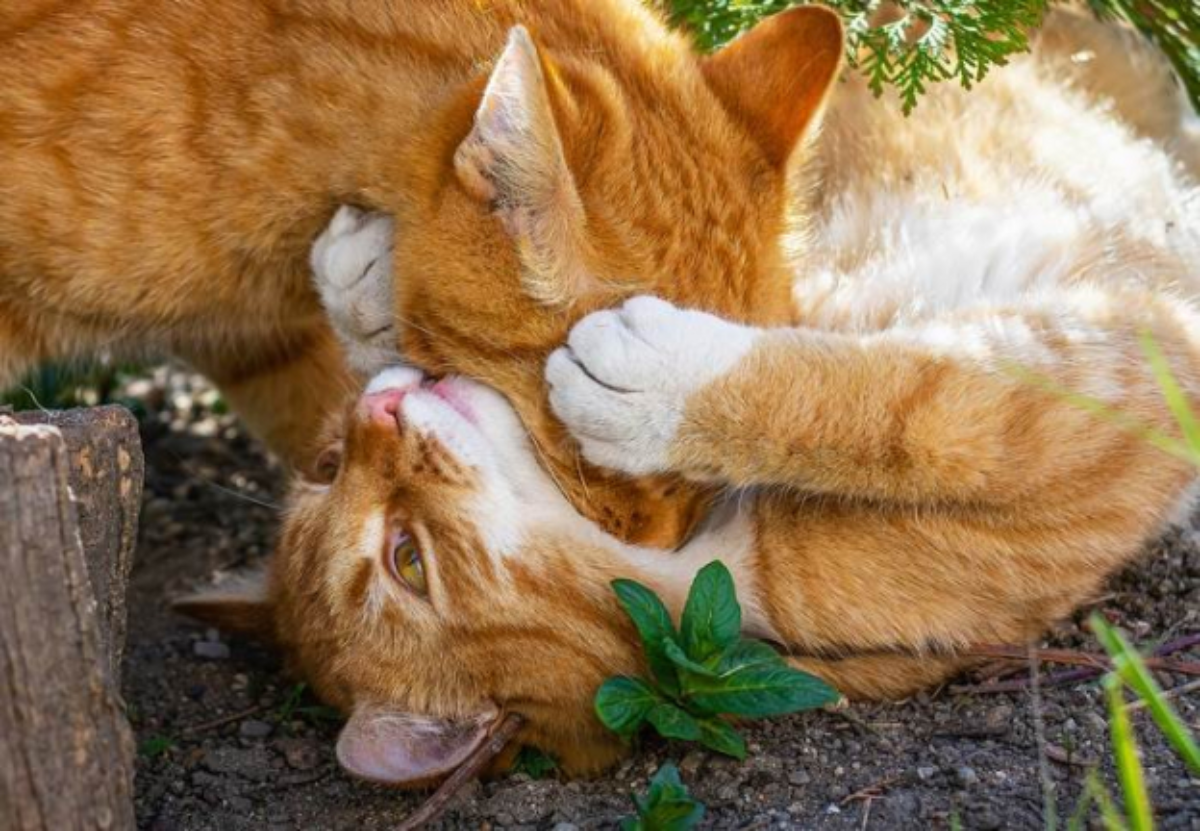
Play fighting is the context most cat owners encounter first when they witness neck biting between cats, particularly in households with young cats or kittens. Understanding what play actually is — functionally and neurologically — explains why neck biting features so prominently in it.
Play in young mammals is not random behavior. It's functionally structured practice for the activities that will matter in adult life. In cats, the activities that matter most are hunting and, to a lesser extent, fighting for resources and mates. Play fighting between kittens and young cats mirrors the motor sequences of real fighting and real hunting — the stalk, the pounce, the grapple, the bite — but in a context where the stakes are low and the consequences of errors are minimal. This is how young cats learn to calibrate the force of their bites, the precision of their movements, and the situational judgment of when to escalate and when to disengage.
Neck biting in this context is prominent for the same reason it's prominent in real predatory and fighting behavior: it's the target that matters. A kitten practicing the killing bite by targeting a littermate's neck isn't being aggressive — it's rehearsing the precise motor skill that will be important later in exactly the same way that a human child practicing throwing is rehearsing a skill, not trying to injure anyone.
The social learning dimension of play fighting is particularly important for understanding the neck bite's role in this context. The cat receiving the bite is providing real-time feedback about whether the pressure is acceptable — through their own body language, vocalization, and response behavior — that shapes the biter's calibration of how hard they can bite. A kitten who bites too hard learns this because their play partner yelps, disengages, and refuses to continue playing. A kitten who consistently bites too hard doesn't get play partners, which is a socially costly outcome that creates behavioral pressure toward appropriate force calibration.
This is why the social learning dimension of play fighting is best completed when kittens are exposed to multiple play partners — littermates, other young cats — during the socialization period. A kitten raised entirely without other cats to interact with misses this calibration process and may have difficulty with bite inhibition as an adult, producing play interactions that seem more intense or rough than those of cats who were properly socialized.
What to watch for: In play between cats, both animals should be active participants, roles should alternate — both cat A biting cat B's neck and cat B biting cat A's neck — body postures should remain relatively loose and fluid rather than rigid and tense, and vocalizations should be absent or minimal. Silent play, even vigorous and physical play, is almost always genuine play. Play that produces hissing, growling, or sustained vocalization from either participant is signaling that the interaction has crossed from play into something more genuinely conflicted.
An important distinction that the source material raises and that deserves clear elaboration: if an adult cat bites you — a human — during what seemed to be a calm, affectionate petting session, this is categorically different from play fighting between cats. This behavior, sometimes called a "love bite" or "petting-induced aggression bite," is a communication signal meaning "I have reached my stimulation threshold and want this to stop now." It's not aggression in the threatening sense. It's a boundary communication delivered in the most emphatic language available to a cat. The appropriate response is to recognize the warning signals that typically precede it — skin rippling, tail flicking, ears rotating back, subtle body tension — and stop petting when those appear, before the bite becomes necessary.
Reason Three: Dominance, Hierarchy, and Resource Management
As cats reach sexual and social maturity — typically between one and three years of age — the playful, low-stakes social interactions of young cats are overlaid with a new dimension: genuine competition over resources and the establishment of social hierarchy that manages that competition.
Cats are not purely solitary animals, despite the common characterization. In environments where resources are concentrated, cats form structured social groups with consistent, recognizable relationship patterns between individuals. These relationships involve relative status — which cat defers to which when they approach the same resource — and the neck bite is one of the behavioral mechanisms through which status is asserted and confirmed.
The dominant cat biting a subordinate cat's neck is, in this context, a physical enactment of social precedence. The subordinate cat's response — submissive posturing, disengagement from the contested resource, allowing the dominant cat to proceed — confirms the status relationship and stabilizes it for future interactions. Well-established hierarchies where everyone knows their position are actually more peaceful than poorly-established or unstable ones, because the need to physically contest resources diminishes when the outcome is already understood.
In multi-cat households, this hierarchy establishment is particularly visible when new cats are introduced into an existing group. The resident cats have established relationships with each other, and the new cat's arrival disrupts those established patterns, requiring a renegotiation process. This renegotiation involves various social behaviors including neck biting, and it can look alarming to owners who haven't seen it before. Some degree of this behavior during the integration period is normal and expected. What makes it potentially problematic is when the integration is handled in a way that prevents the hierarchy from establishing — when well-meaning owners intervene in every interaction, preventing the cats from ever settling into a stable relationship pattern.
The resources over which hierarchy matters in domestic multi-cat households are specific and practical: sleeping spots, particularly elevated or particularly comfortable ones; food and water bowls and the timing of access to them; litter boxes and their positions; access to human attention and affection; and physical territory more generally — which cat has primary claim on which rooms or areas of the house.
In households where resources are genuinely scarce relative to the number of cats — too few litter boxes, feeding arrangements that require cats to crowd together, limited vertical space — the competition pressure that drives dominance-asserting behavior including neck biting stays chronically elevated. This creates ongoing conflict rather than the periodic assertion-and-confirmation cycle that would stabilize into a workable hierarchy if resources were adequate.
What to watch for: Dominance-context neck biting is typically accompanied by body language that distinguishes it from play — the dominant cat's posture is rigid and deliberate rather than loose and bouncy, the subordinate cat's response involves submissive signaling (lowered posture, averted gaze, flattened ears) rather than playful reciprocal engagement, and the interaction is centered on a specific resource or location rather than being mobile and shifting as play typically is. Growling, hissing, and sustained body tension from either cat are more characteristic of dominance conflict than of play.
The management response to chronic dominance-driven neck biting in multi-cat households centers on resource provision rather than behavioral punishment — adding litter boxes, feeding cats in separate spaces or on separate schedules, providing additional elevated resting spots, and generally reducing the competition pressure that makes frequent assertion necessary.
Reason Four: Retained Predatory Instincts
The fourth reason for neck biting in cats sits at the intersection of play and predation — or more precisely, it represents the predatory drive expressing itself through available targets in a domestic environment where actual prey animals aren't typically present.
Indoor cats don't hunt. But the drive to hunt, which is hardwired rather than learned, doesn't simply switch off because the hunting context isn't available. It expresses itself through the behaviors that hunting would involve — the stalk, the pounce, the grab, the bite — directed toward whatever is available. Toys, when provided, serve this function. Housemate cats, when toys are less interesting or when the predatory drive is particularly activated, can also serve this function, often to the housemate's considerable annoyance.
Predatory play aimed at a housemate typically looks different from either social play or dominance assertion. It has a quality of focused, intense pursuit — the hunting cat may stalk the housemate from hiding, launch a sudden pounce attack, and specifically target the back of the neck in the way that would immobilize prey. The target cat, for their part, typically hasn't been an active participant in preceding play and didn't choose to engage — they were simply going about their business and were ambushed.
This ambush quality, where one cat initiates sudden intense contact with a housemate who wasn't participating in any prior social interaction, is one of the behavioral signatures of predatory-drive-driven neck biting. The target cat's response is often more alarmed and defensive than the responses typical of play or dominance interactions, because from the target's behavioral perspective, they were just attacked out of nowhere.
What to watch for: Predatory-drive-driven neck biting is most likely in households where a more active or younger cat isn't getting adequate stimulation and outlet for their prey drive through appropriate toys and interactive play. The management response centers on providing adequate predatory enrichment to the attacker — multiple interactive play sessions daily with toys that satisfy prey-chasing and catching behavior — rather than on trying to manage the interaction with the target cat directly.
A cat who redirects predatory energy into ambushing a housemate is, more often than not, a cat who is understimulated and whose drive has nowhere appropriate to go. Providing appropriate outlets doesn't just reduce the housemate conflicts — it improves the attacker cat's overall wellbeing, which is connected to whether that fundamental drive is being adequately expressed.
Reason Five: Medical Causes and Pain-Driven Aggression
The fifth reason cats bite each other's necks is the one most important to recognize promptly and the one most commonly missed: sudden, new, or escalating neck biting — particularly in a cat who didn't previously show this behavior — can be a signal of underlying pain, illness, or neurological change.
This connection runs through a mechanism that affects almost every species of social animal: pain and discomfort produce behavioral defensiveness. An animal in pain is an animal in a state of heightened threat perception and reduced threshold for defensive response. Where a comfortable, healthy cat might ignore a housemate's approach to the same resource, or respond with mild assertion but not escalation, a cat in pain perceives the same approach as a potential threat to be preempted. The defensive aggression that results — which can include neck biting aimed at driving the perceived threat away — isn't territorial or predatory in motivation. It's protective, a response to the vulnerability that pain creates.
Several specific conditions are worth knowing about in this context:
Arthritis and chronic joint pain are common in middle-aged and older cats and frequently underdiagnosed because cats mask pain so effectively. A cat with arthritic hips or spine who is bumped, jumped on, or even approached by a housemate cat in a way that creates the possibility of physical contact may bite defensively before actual contact occurs — preempting an anticipated pain rather than responding to actual pain. Owners often describe this as the cat "suddenly becoming aggressive" without recognizing that the cat has been in increasing pain for some time and has reached a threshold where even proximity to other cats feels threatening.
Hyperthyroidism — a condition involving overproduction of thyroid hormone that's particularly common in cats over ten years old — produces systemic metabolic changes that include elevated irritability and reduced tolerance for stimulation. The hormonal shift doesn't cause pain directly but creates a baseline physiological state in which the cat's arousal threshold is lower and their reactive aggression is more easily triggered. A hyperthyroid cat who seems generally more irritable, more reactive, and more prone to sudden aggression — including neck biting — than they were previously is showing a behavioral change driven by physiology rather than by any deliberate change in social strategy.
Neurological conditions affecting the brain directly can produce behavioral changes including sudden, apparently unmotivated aggression that may include neck biting. These conditions — brain tumors, encephalitis, certain metabolic encephalopathies — affect the neurological structures that regulate behavioral inhibition and arousal, producing behavior that can seem bizarre or completely out of character precisely because the normal regulatory mechanisms have been disrupted. A cat showing sudden behavioral changes alongside other neurological signs — seizures, altered consciousness, changes in gait, pupillary abnormalities — is showing a combination that warrants urgent veterinary assessment.
What to watch for: The critical diagnostic clue that distinguishes medically-driven aggression from social or predatory aggression is temporal change — specifically, a behavior that has newly appeared or significantly escalated in a cat whose previous behavior in this area was different. A cat who has always been somewhat assertive with housemates and continues to be is showing a stable characteristic. A cat who was previously calm and tolerant with housemates and has suddenly become prone to neck biting or aggressive encounters is showing a change that deserves investigation.
Accompanying signs that strengthen the case for a medical investigation: changes in activity level or mobility, changes in appetite or weight, changes in vocalization patterns, any signs of pain when being touched, changes in litter box behavior, or any other departure from the cat's established normal that accompanies the behavioral change.
Reading the Body Language — The Critical Skill
Why Context and Body Language Are Everything
The five reasons for neck biting described above cannot be reliably distinguished from each other by the neck bite action itself. The physical act is similar across contexts. What provides the distinguishing information is the full behavioral context — what led up to the neck bite, what the body language of both cats looks like during and around the interaction, and what follows from it.
Learning to read feline body language accurately is one of the most useful skills a multi-cat household can develop, and the following is a guide to the specific signals most relevant to understanding neck biting incidents.
Signals of Play
Play postures in cats have a characteristic looseness and mobility that distinguishes them from the rigid, deliberate postures of genuine conflict. A cat engaged in play has:
- A loose, mobile body that bounces, pivots, and shifts direction easily rather than holding a fixed, tense position
- A tail that may be up or may curl in an arc, but moves rather than being held rigid or lashing side to side
- An open, active posture with weight balanced for movement rather than braced in a defensive crouch
- No sustained vocalizations — play is typically silent or accompanied by very brief sounds, not ongoing growling, hissing, or yowling
- Alternating engagement — both cats take turns pursuing and being pursued, biting and being bitten, rather than one cat consistently imposing and the other consistently receiving
- Easy, quick disengagement — play partners separate easily when one wants to stop, without the clinging, gripping quality of genuine fighting
When these signals are present across both cats in an interaction, it's play. Let it continue.
Signals of Dominance Conflict
Dominance assertion and genuine social conflict carry a different bodily signature:
- Rigid, deliberate posture in the initiating cat — weight forward, head lowered, an unmistakable quality of intention
- Submissive posture in the receiving cat — lowered body, flattened ears, averted gaze, possibly crouching — or alternatively, a defensive posture if the receiving cat isn't accepting the subordinate role
- Resource-centeredness — the interaction is happening over or near a specific location, bowl, or spot rather than moving around the room
- Vocalization — hissing, growling, low yowling are common accompaniments to genuine social conflict
- Non-alternating roles — one cat consistently dominates, the other consistently receives
- Staring — prolonged, direct eye contact between cats is a threatening signal, not neutral
When these signals are present, the interaction is genuine conflict rather than play. Whether intervention is required depends on whether the subordinate cat has a way to safely disengage and access their own space, food, and litter box without being blocked. If they do, allowing the hierarchy to continue establishing is appropriate. If the dominant cat is blocking access to essential resources, environmental modification is needed.
Signals of Medical or Fear-Based Aggression
Pain-driven or fear-driven aggression has its own distinguishing features:
- Sudden onset or significant escalation in a cat who didn't previously show this behavior
- Disproportionate intensity for the triggering event — a response that seems excessive relative to what provoked it
- Defensive rather than pursing quality — the aggression is oriented toward making a threat go away, not toward pursuing a resource
- Accompanying behavioral changes — reduced mobility, changed appetite, altered vocalizations, litter box changes, or any other systemic change
- Specific location sensitivity — aggression triggered by contact with a particular body area (suggesting pain at that site) rather than by proximity generally
- Quick disengagement once the threat retreats rather than the persistent following behavior of genuine territorial aggression
When these signals are present, veterinary assessment is the appropriate next step rather than behavioral management.
Management Strategies for Each Context
Managing Play Between Cats
Play between cats generally doesn't need management — it needs facilitation. Providing an environment that supports healthy play reduces the intensity of play interactions by distributing energy across more outlets:
Multiple play sessions daily with interactive toys that satisfy the predatory drive reduce the intensity and duration of cats playing rough with each other. A cat who has already had two satisfying wand toy sessions and a round with a feather teaser is less likely to direct intense predatory energy at a housemate than one who has been doing nothing all day.
Adequate space — particularly vertical space through cat trees and shelves — provides different interactive opportunities and allows cats to disengage from each other when play has run its course, reducing the likelihood that play continues past the point where one participant wants to stop.
For kittens or young cats showing very rough play, brief time-outs that separate them when play escalates beyond mutual engagement are appropriate — not as punishment but simply as circuit-breakers that interrupt escalating cycles before they become habitual patterns.
Managing Dominance in Multi-Cat Households
The most impactful management intervention for dominance-driven conflict in multi-cat households is resource provision. The general guidelines:
Litter boxes: One box per cat plus one. In a three-cat household, four boxes minimum, positioned in different locations so that a dominant cat cannot guard all of them simultaneously.
Feeding: Separate food stations, ideally in different rooms or at different heights, where no cat has to compete for proximity to eat. Timed or scheduled feeding that removes food access between meals reduces the chronic resource pressure that keeps competition elevated.
Resting spaces: Multiple elevated options — cat trees, shelves, window perches — that give every cat the ability to choose a space where they're not immediately adjacent to a cat whose proximity is stressful.
Human attention: Individual attention sessions with each cat, particularly in multi-cat households where one cat may monopolize human lap time in ways that deprive others of their social needs being met.
The goal of all of these interventions is reducing the competition pressure that makes frequent dominance assertion necessary. When resources are adequate, cats establish a working hierarchy and then largely live within it without needing to constantly reassert it.
Managing Predatory Ambush Behavior
A cat who is ambushing housemates out of predatory drive needs more prey-behavior outlets:
Daily interactive play sessions — not toys left on the floor, but active, human-operated play that simulates the movement patterns of prey and allows the cat to complete the full predatory sequence of stalk, chase, pounce, catch — are the core intervention. This isn't enrichment as a nicety. For a cat with a high, unsatisfied predatory drive, it's behavioral health management.
Puzzle feeders that require the cat to work for their food provide a pale but genuine substitute for the foraging component of the hunting sequence and extend daily behavioral engagement in ways that reduce the pressure the drive creates.
If the ambushing behavior is targeted at a specific housemate consistently, temporarily separating that pair and gradually reintroducing them with positive associations — feeding both cats on opposite sides of a closed door, then a cracked door, then in the same room at a distance — can reset the relationship pattern.
Responding to Medical Aggression
When aggression is suspected to have a medical component, the management step is a veterinary assessment, not a behavioral intervention. Trying to manage medically-driven aggression through behavioral techniques alone is ineffective and does nothing for the cat's underlying discomfort.
A full physical examination, bloodwork including thyroid screening for older cats, orthopedic assessment if joint pain is suspected, and neurological evaluation if behavioral changes suggest neurological involvement — these are the appropriate first responses to a cat showing sudden or significantly escalated aggression.
Managing the home environment during the diagnostic period — temporarily separating the affected cat from housemates who trigger the aggressive response, reducing stimulation, ensuring the cat has comfortable, accessible resting spots that don't require jumping or climbing that might cause pain — provides welfare support for the cat while the underlying cause is being investigated.
When to Involve a Professional
The Decision Threshold
Most neck biting between cats in most households doesn't require professional involvement — it's normal social behavior that falls well within the range of what cats do when they live together. The threshold for professional consultation — either veterinary or with a certified feline behavior specialist — is reached when:
Injuries are occurring. If either cat is being bitten hard enough to produce puncture wounds, lacerations, or abscesses from infected bite wounds, the behavior has escalated beyond what normal play or dominance assertion produces. Real fighting carries real injury risk, and injuries introduce infection risk that's genuinely serious.
A medical cause is suspected. Any sudden behavioral change in an otherwise stable cat — particularly in a middle-aged or older cat — warrants veterinary evaluation before behavioral management is attempted.
The social environment is chronically stressed. Cats who are consistently unable to access their essential resources — food, water, litter boxes, safe resting space — because of ongoing conflict are experiencing sustained welfare compromise that needs to be addressed. The stress of chronic conflict affects immune function, urinary tract health, and overall wellbeing in ways that are real and cumulative.
Outdoor conflict is a regular occurrence. Cats allowed outdoor access who are regularly engaged in territorial fights with neighborhood cats face injury and infection risk from those fights alongside the psychological stress of ongoing territorial contestation. An evening curfew — keeping cats inside during the periods when outdoor territorial conflict is most likely, typically dusk and overnight — significantly reduces outdoor fighting without requiring full indoor confinement.
Home interventions aren't working. If you've genuinely tried the environmental modifications described above — adequate resources, space, interactive play — and conflict remains consistently high, a consultation with a certified veterinary behaviorist or feline behavior specialist can identify patterns and interventions that aren't obvious from a general guide.
Conclusion: Context Is Everything
Neck biting in cats is one of those behaviors that demonstrates why cat behavior is genuinely rich and genuinely complex, rather than being the simple read that "cats are mysterious and unknowable" suggests. It's not mysterious at all, once you understand the five contexts in which it occurs. It's actually quite legible — the behavior carries clear meaning in each context, and that meaning is readable through the body language and circumstance surrounding it.
What makes it seem confusing is that the same physical action means five different things, and responding appropriately requires reading the context rather than reacting to the action itself. A knee-jerk intervention in play disrupts a normal, healthy social interaction. Treating medical aggression as a behavioral problem misses the real issue. Dismissing dominance conflict as normal roughhousing without providing the environmental support that would allow the hierarchy to stabilize keeps cats in unnecessary ongoing stress.
The investment in learning feline body language — really learning it, to the point where you can read a cat's posture and vocalization and movement and know what they're communicating — pays dividends across every aspect of living with cats, not just in understanding neck biting. It makes you a more responsive, more effective, more empathetic cat owner. And it usually reveals that the cats in your household are communicating quite clearly, in a language that's been available to learn the whole time.
FAQ
1. Why do cats bite each other on the neck?
Cats bite each other's necks for several natural reasons, including play, social dominance, mating behavior, predatory instincts, maternal care, or medical-related aggression. The meaning depends entirely on the surrounding body language and situation. A playful neck bite is very different from an aggressive or pain-driven bite.
2. Is neck biting between cats normal?
Yes. Neck biting is considered a normal feline behavior when it occurs during healthy play, social interactions, or mating. It only becomes a concern when it causes injuries, excessive fear, chronic bullying, or sudden behavioral changes.
3. How can I tell if cats are playing or fighting?
During play:
- Bodies remain loose and relaxed.
- Both cats take turns chasing each other.
- There is little or no hissing.
- They stop voluntarily.
- No serious injuries occur.
During a fight:
- Fur stands on end.
- Ears flatten backward.
- Loud growling, hissing, or screaming occurs.
- One cat constantly chases while the other tries to escape.
- Blood or bite wounds may result.
4. Why does one cat always bite the other's neck?
A cat may repeatedly bite another cat's neck because:
- It is establishing social hierarchy.
- It has excess hunting energy.
- It enjoys rough play.
- It is attempting to mate.
- It is reacting to stress or pain.
Observing the surrounding behavior helps determine the true cause.
5. Why do male cats bite female cats on the neck?
Male cats naturally bite the female's scruff during mating. This behavior helps stabilize the female during breeding and is part of normal feline reproductive behavior.
6. Do female cats ever bite other cats' necks?
Yes. Female cats may bite:
- Their kittens while carrying them.
- Other adult cats during play.
- Cats competing for territory or resources.
- Cats during defensive conflicts.
7. Why do mother cats carry kittens by the neck?
Mother cats gently grip the loose skin (scruff) behind a kitten's neck because kittens naturally relax during transport. This instinct helps mothers safely move their babies to new nesting locations.
8. Is neck biting painful?
It depends.
A gentle play bite usually causes little or no pain.
A forceful bite may puncture the skin, damage tissue, cause infection, or create abscesses requiring veterinary treatment.
9. Should I stop my cats when they bite each other's necks?
Only if you notice:
- Blood
- Screaming
- Continuous bullying
- Fearful hiding
- One cat unable to escape
- Injuries
If both cats appear relaxed and continue taking turns during play, intervention usually isn't necessary.
10. Can kittens learn bite control through neck biting?
Yes.
Play fighting teaches kittens:
- Bite inhibition
- Social boundaries
- Hunting skills
- Communication
- Self-control
This learning process is an important part of healthy development.
11. Why does one cat pin another cat down while biting its neck?
Pinning behavior often indicates:
- Dominance
- Rough play
- Mating attempts
- Predatory play
Body language determines which explanation fits the situation.
12. Does neck biting mean cats hate each other?
No.
Many bonded cats wrestle, chase, and gently bite each other's necks daily while maintaining a strong friendship.
True hostility includes:
- Constant intimidation
- Resource blocking
- Serious injuries
- Persistent fear
13. Can stress cause neck biting?
Yes.
Stress from:
- Moving house
- New pets
- New babies
- Loud environments
- Limited territory
can increase aggressive interactions between cats.
14. Can medical problems cause sudden neck biting?
Absolutely.
Conditions that may trigger aggression include:
- Arthritis
- Hyperthyroidism
- Dental pain
- Neurological disease
- Chronic pain
- Brain disorders
Sudden behavioral changes always deserve veterinary attention.
15. What body language indicates playful neck biting?
Signs include:
- Relaxed ears
- Soft eyes
- Bouncy movements
- Taking turns
- Quiet behavior
- Brief wrestling
These indicate mutual enjoyment rather than aggression.
16. What body language indicates aggressive neck biting?
Warning signs include:
- Flattened ears
- Dilated pupils
- Puffing fur
- Growling
- Hissing
- Rigid posture
- Persistent chasing
- Tail lashing
These suggest conflict rather than play.
17. Why does my older cat suddenly bite younger cats?
Older cats may develop:
- Arthritis
- Vision loss
- Hearing loss
- Chronic pain
- Hormonal disorders
These conditions reduce patience and increase defensive aggression.
18. Can boredom make cats bite each other?
Yes.
Cats lacking:
- Daily exercise
- Interactive toys
- Hunting games
- Mental stimulation
may redirect excess energy toward housemates.
19. How can I reduce neck biting between my cats?
Helpful strategies include:
- Daily interactive play sessions
- Multiple scratching posts
- Cat trees
- Separate feeding stations
- Multiple litter boxes
- Puzzle feeders
- Vertical climbing areas
- Quiet resting spaces
These reduce competition and boredom.
20. How many litter boxes should multiple cats have?
Behaviorists generally recommend:
One litter box per cat, plus one extra.
For example:
- 2 cats = 3 litter boxes
- 3 cats = 4 litter boxes
- 4 cats = 5 litter boxes
21. Can territorial behavior lead to neck biting?
Yes.
Cats may bite another cat's neck when competing over:
- Food
- Water
- Sleeping areas
- Window perches
- Favorite humans
- Territory
Increasing available resources often reduces conflict.
22. Are indoor cats more likely to bite housemates?
Indoor cats with insufficient enrichment may redirect their natural hunting instincts toward companion cats. Providing structured play and environmental enrichment greatly reduces this behavior.
23. When should I contact a veterinarian?
Seek veterinary care if your cat:
- Suddenly becomes aggressive
- Develops bite wounds
- Shows mobility problems
- Stops eating
- Changes litter box habits
- Appears painful
- Experiences repeated fights
- Has unexplained behavioral changes
24. Can neck bites become infected?
Yes.
Cat mouths contain bacteria that easily cause:
- Abscesses
- Swelling
- Fever
- Pain
- Skin infections
Even small puncture wounds should be monitored closely.
25. Can two friendly cats still bite each other's necks every day?
Yes.
Many bonded cats regularly:
- Wrestle
- Chase
- Neck bite
- Groom each other
- Sleep together afterward
These behaviors are often part of healthy feline social interaction rather than aggression.