The Evolutionary Psychology and Clinical Realities of Feline Food Caching: Behavioral Drivers, Nutritional Management, and Stress Diagnostics
2 months ago · Updated 2 months ago
For the modern pet parent, the domestic cat (Felis catus) is a source of endless fascination and occasional bewilderment. Among the long list of idiosyncratic behaviors that puzzle cat owners—such as midnight racing, obsessive grooming, and intense staring contests with blank walls—few habits are as common or as misunderstood as food covering, or food caching.
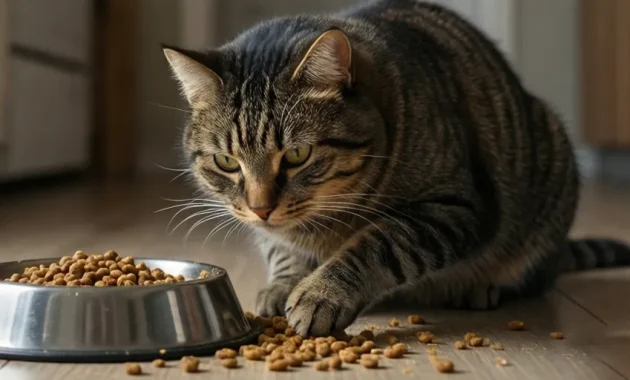
You walk into the kitchen and see your cat meticulously pawing, scratching, and scraping at the hardwood floor, tile, or a plastic mat surrounding their food bowl. In some cases, they might even drag a nearby dish towel, loose blanket, or piece of paper over the bowl, completely hiding their remaining kibble or wet food from view.
To the human observer, this looks like a quirky, slightly nonsensical habit. After all, the indoor cat lives in a highly protected environment, completely insulated from the harsh realities of the wild, with a reliable supply of premium meals served on a predictable schedule.
However, from an evolutionary, biological, and behavioral standpoint, this scratching is far from random. It is a deeply ingrained, highly functional survival mechanism inherited directly from their wild ancestors.
This comprehensive guide breaks down the evolutionary psychology behind feline food caching, explores the distinct triggers that drive domestic cats to bury their meals, provides diagnostic tools to differentiate between natural instincts and stress-induced anxiety, and outlines practical, veterinary-approved solutions to manage this behavior in your home.
The Evolutionary Blueprint: Deep Ancestry and DNA
To understand why a pampered house cat feels a sudden, urgent need to hide a half-empty bowl of premium wet food, we must look backward through evolutionary time.
                 [ THE GENETIC CONNECTION ]
                             │
       +---------------------+---------------------+
       |                                           |
 [ African Wildcat: Felis lybica ]          [ Panthera tigris: The Tiger ]
 - Shared lifestyle and hunting habits.      - 95.6% shared DNA matrix.
 - Foundational solitary hunting style.      - Apex predators with caching instincts.
 - Same territorial and survival drives.     - Natural urge to protect food assets.
The domestic cats sleeping on our beds are not far removed from the wild. Genetically, they are almost identical to the African wildcat (Felis lybica), a small, solitary predator native to the deserts and savannas of Africa and the Arabian Peninsula. Furthermore, genomic sequencing has revealed that our domestic felines share a staggering 95.6% of their DNA with tigers (Panthera tigris).
This means that while cats have spent thousands of years living alongside humans, their brains remain wired with the primitive survival instincts of wild apex predators. In the wild, food management is not a matter of preference—it is a matter of life and death. Wild felines utilize food covering, or caching, for several critical reasons:
1.1 Scent Masking: Predator and Competitor Avoidance
In their natural habitats, smaller wild cats occupy a unique and dangerous ecological niche: they are both predators and prey. While they hunt small rodents, birds, and insects, they are simultaneously hunted by larger, more dominant carnivores, such as leopards, hyenas, jackals, and large birds of prey.
Leftover food, particularly raw meat, decomposes rapidly. As it spoils, it releases volatile organic compounds that create a strong, distinct scent trail. For a solitary wild cat, leaving a pungent carcass exposed in their core territory is the equivalent of sending a beacon to every large predator in the area.
Burying the remains under dirt, sand, leaf litter, or debris acts as a natural scent barrier. By trapping the odor molecules beneath the earth, the cat effectively masks their tracks, lowering the risk of a dangerous encounter with a larger predator or a rival cat looking to defend its territory.
1.2 Asset Protection from Scavengers
Hunting is an energy-intensive, high-risk activity. A wild cat must expend significant metabolic energy to stalk, chase, and subdue prey, and many hunting attempts end in failure. Therefore, a successful kill represents a highly valuable thermodynamic asset.
[Successful Hunt] ──► [High Metabolic Cost] ──► [Valuable Food Asset]
                                                        │
                                                        ▼
[Exposed Carcass] ──► [Attracts Avian/Mammalian Scavengers] ──► [Loss of Calories]
                                                        │
                                                        ▼
[Surgical Burial / Caching] ──► [Scent Contained] ──► [Food Asset Secured]
Once a cat has eaten their fill, any remaining meat is vulnerable to opportunistic scavengers, such as vultures, crows, foxes, and insects. By carefully covering the carcass, the cat hides it from sight and smell, preserving the valuable calories so they can return to finish the meal later when their stomach has emptied.
1.3 The Maternal Instinct: Protecting Vulnerable Offspring
For pregnant or nursing queens in the wild, food management becomes even more critical. A mother cat with a litter of hidden, immobile kittens is heavily restricted in her movements. She cannot easily move her nest if a large predator discovers her location.
If a queen catches a large meal and leaves the leftovers rotting near her den, the scent will inevitably attract unwanted attention, putting her vulnerable kittens at extreme risk. Mother cats possess a powerful, hardwired instinct to bury every trace of uneaten food, blood, and waste far away from their nesting site to keep their family invisible to predators.
Deciphering the Triggers: Why Indoor Cats Cache Food
When your indoor cat scratches at the floor around their bowl, they are executing a fixed-action pattern—an instinctive series of movements triggered by specific environmental cues. Because there is no dirt or leaf litter on your kitchen floor, they simply scrape at the air, the tile, or whatever loose items are nearby.
Understanding the specific triggers behind this behavior helps owners optimize their home environment.
                      [ INTERNAL TRIGGERS FOR CACHING ]
                                      │
       +------------------------------+------------------------------+
       |                                                             |
 [ Hyper-Satiety Control ]                                   [ Olfactory Cleanliness ]
 - Served portions exceed stomach volume.                    - Decaying wet food generates foul odors.
 - Instinct forces them to "save for later."                  - Natural drive to sanitize core territory.
 - Prevents asset theft by household pets.                   - Cleans the space to prevent disease.
2.1 Hyper-Satiety and the "Save for Later" Response
The feline stomach is anatomically small, roughly the size of a ping-pong ball in an average 4 kg cat. In the wild, cats are designed to eat multiple small, protein-dense meals throughout the day and night rather than consuming one or two large portions.
When a well-meaning owner places a large scoop of kibble or a full can of wet food into a bowl, the cat often fills their stomach quickly, leaving a substantial amount of leftovers. The physical presence of uneaten, highly valuable protein triggers the hyper-satiety response. Even though the cat knows another meal is guaranteed, their ancient genetic programming forces them to perform the motions of caching to secure the remaining food asset for later.
2.2 Olfactory Cleanliness and Environmental Maintenance
Cats are fastidiously clean animals, spending up to 30% to 50% of their waking hours grooming their fur to remove dirt, loose hair, and external odors. This cleanliness is a survival strategy; a scentless predator is a highly effective hunter.
This desire for cleanliness extends directly to their living and eating spaces. Wet food left out at room temperature begins to dry, oxidize, and spoil within a few hours, releasing a strong smell that cats find unpleasant.
When a cat scratches around a stale bowl of food, they are often attempting to clean up their core territory. To their mind, an exposed, strong-smelling food source is messy, unhygienic, and a potential magnet for unwanted attention, so they try to bury it just like they cover their waste in the litter box.
2.3 Intra-Household Competition: The Multi-Pet Dynamic
In homes with multiple cats, dogs, or other animals, food covering frequently points to subtle, unspoken competition over resources.
Even if your pets appear to get along smoothly, cats are naturally solitary surface hunters that prefer to eat, drink, and eliminate in complete isolation. If a cat feels the watchful eyes of another household pet while eating, their protective instincts kick into overdrive. They will try to bury their bowl to hide the food from potential thieves, ensuring their housemates cannot slide in and steal their leftovers.
Diagnostic Differentiation: Instinct vs. Pathology
While food scratching is usually a completely normal, healthy manifestation of feline instinct, it can occasionally serve as a warning sign for chronic stress, behavioral anxiety, or medical issues. Owners must learn how to differentiate between standard behavioral expression and clinical problems.
[Observing Caching Behavior] ──► [Analyze Secondary Systemic Variables]
                                               │
                                               ▼
     +-----------------------------------------+-----------------------------------------+
     |                                                                                   |
[ Normal Instinctive Profile ]                                              [ Pathological Stress Profile ]
- Cat eats normally, then scratches briefly.                                - Cat displays hyper-vigilance or avoidance.
- Body posture is relaxed and neutral.                                      - Hissing, hiding, or pacing around meals.
- Maintains stable weight and vitality.                                     - Accompanied by chronic vomiting or weight loss.
3.1 Differentiating Behavioral Profiles
To evaluate whether your cat's food-covering behavior requires intervention, compare their habits against the following clinical criteria:
-
The Healthy Instinctive Profile: The cat approaches the bowl with a relaxed, confident posture. They eat a healthy portion of their food, walk away satisfied, and spend 30 to 60 seconds gently scratching at the floor before moving on to groom themselves or sleep. The behavior is calm, brief, and has no negative impact on their quality of life.
-
The Pathological Stress Profile: The cat appears visibly tense, hyper-vigilant, or agitated around the food bowl. They may glance around anxiously, keep their ears flattened (airplane ears), or pace back and forth. Instead of eating, they may instantly start scratching aggressively at the floor or walls without touching a single bite of food. This intense, obsessive scratching often indicates that the cat feels deeply unsafe in their eating environment.
3.2 Medical Causes of Food Rejection and Burying
If a cat suddenly starts burying their food bowl without eating anything at all, it often points to an underlying medical issue that requires a veterinary checkup:
                  [ MEDICAL TRIGGERS FOR FOOD AVOIDANCE ]
                                     │
       +-----------------------------+-----------------------------+
       |                                                           |
 [ Acute Nausea / Gastrointestinal ]                         [ Advanced Periodontal Disease ]
 - Gastritis, inflammatory bowel, or organ disease.          - Severe tooth resorption or gingivitis.
 - Food aroma triggers immediate nausea.                     - Cracking dry kibble causes acute pain.
 - Cat buries food to remove nausea trigger.                 - Cat hides food out of fear of physical pain.
-
Systemic Nausea: Conditions like chronic kidney disease (CKD), hepatic lipidosis, gastritis, or inflammatory bowel disease (IBD) cause a buildup of toxins in the blood, leading to chronic nausea. When a nauseous cat approaches food, the strong aroma can trigger an immediate wave of revulsion. The cat scratches at the bowl not to save the food, but to remove the smell that is making them feel sick.
-
Advanced Dental and Oral Pain: Cats suffering from feline odontoclastic resorptive lesions (FORLs), severe gingivitis, or fractured teeth feel sharp, agonizing pain when they try to chew hard kibble or cold wet food. Because they are hungry, they will approach the bowl, but the fear of physical pain stops them from eating. They scratch at the floor out of frustration or to hide the food source that they want to eat but cannot manage comfortingly.
-
Spoiled or Rancid Food: A cat's sense of smell is roughly 14 times stronger than a human's. If dry kibble has sat open for months, the natural fats inside can oxidize and turn rancid long before a human notices a difference. If a cat detects spoilage, mold, or chemical contamination, they will reject the meal and try to bury it to clean up their space.
Systematic Management: Veterinary-Approved Home Solutions
If your cat's food-covering habit is completely instinctive and they are healthy, you do not technically need to stop it. However, if the constant scratching is damaging your floors, causing a mess, or turning into a source of stress in a multi-pet home, you can easily modify the behavior using structured environmental changes.
[Identify Caching Issue] ──► [Implement Portion Controls] ──► [Establish Isolated Stations]
                                                                        │
                                                                        ▼
[Introduce Protective Mats] ──► [Incorporate Cognitive Puzzles] ──► [Behavioral Harmony]
4.1 Transitioning to Micro-Portion Feeding Architectures
The most effective way to eliminate the food-burying reflex is to remove the primary trigger: leftovers.
-
Abandon Free-Feeding: Leaving a giant bowl of dry kibble out all day keeps the cat's caching instincts constantly active. Switch to a structured feeding schedule.
-
Utilize Automated Micro-Feeders: Transition your cat to receiving four to six tiny, precisely measured meals throughout the day and night. Automated feeders can be programmed to dispense exact gram amounts on a strict schedule. Because the portions match the natural size of the feline stomach, your cat will finish the meal completely, leaving zero leftovers to trigger the urge to bury.
4.2 Optimizing the Resource Layout in Multi-Pet Homes
To eliminate anxiety-driven food covering, you must create a secure, stress-free dining environment:
-
The Rule of Separation: Never feed multiple cats side-by-side from double bowls or adjacent dishes. Place feeding stations in entirely different rooms, or on opposite sides of a solid wall, so your pets cannot see or hear each other while eating.
-
Leverage Vertical Elevation: Cats feel incredibly secure when they are high off the ground, where predators cannot surprise them. Move your cat's food bowl to an elevated space, such as a sturdy countertop, a cleared windowsill, or a dedicated cat wall shelf. This elevation removes them from the path of dogs or other pets, lowering their anxiety and eliminating the need to hide their food.
                      [ MULTI-PET RESOURCING PLATFORM ]
                                      │
        +-----------------------------+-----------------------------+
        |                                                           |
 [ Microchip-Activated Dishes ]                             [ Vertical Space Optimization ]
 - Bowls open exclusively for one registered pet.           - Elevate feeding bowls to high shelves.
 - Prevents food theft by other animals.                    - Keeps cats out of reach of household dogs.
 - Gives timid cats complete peace of mind.                  - Provides safety and eliminates anxiety.
-
Microchip-Activated Feeding Dishes: For homes where one pet constantly steals food from another, invest in microchip-selective automated feeders. These bowls feature a motorized lid that opens only when it reads the unique microchip or collar tag of the registered cat. When that cat walks away, the lid closes instantly, sealing the food shut. This clear boundary gives a timid cat total peace of mind, stopping the caching instinct because they know their food is locked up safely.
4.3 Environmental Modifications and Cognitive Redirection
-
Install Protective Feeding Mats: If you cannot modify the scratching behavior itself, protect your home from claw damage. Place a large, durable, easy-to-clean silicone or hard plastic mat beneath your cat's feeding dishes. This creates a safe barrier for your floors and makes it easy to wipe away any scattered bits of food.
-
Incorporate Interactive Puzzle Feeders: Replace traditional ceramic bowls with cognitive puzzle toys, licking mats, or rolling food spheres. Force your cat to work, slide, and hunt for their kibble or wet food. This mental exercise channels their primitive hunting and tracking drives constructively, burning through excess cognitive energy and drastically reducing post-meal scratching habits.
The Clinical Spectrum of Companion Animal Wellness
Managing behavioral quirks like food covering is just one piece of the puzzle when it comes to long-term pet health. True wellness requires a comprehensive approach that balances environmental care, specialized nutrition, structural grooming, and targeted medical procedures across all companion animals.
5.1 Feline Lower Urinary Tract Disease (FLUTD) Core Protocols
Just as behavioral stress can manifest as food scratching, it is also the primary trigger for Feline Idiopathic Cystitis (FIC), a major sub-classification of FLUTD. When a cat faces chronic household stress—such as conflict over food bowls or a lack of secure vertical territory—their sympathetic nervous system damages the protective glycosaminoglycan (GAG) lining of the bladder wall.
This breakdown exposes sensitive tissue to highly concentrated urine, causing severe, painful sterile inflammation, bloody urine (hematuria), and dangerous urethral blockages in male cats.
[Chronic Environmental Stress] ──► [GAG Layer Thinning] ──► [Bladder Wall Inflammation] ──► [FLUTD Crisis]
To prevent urinary crises, owners must focus on permanent stress reduction and strict dietary control:
-
Continuous Hydration Access: Provide multiple running water fountains and feed high-moisture wet food to dilute the urine, keeping its specific gravity low to prevent mineral crystals from binding into stones.
-
Targeted Nutritional Chemistry: Feed specialized urinary health diets (like Pro Plan Urinary Care). These formulas limit dietary magnesium and phosphorus while stabilizing urine pH between 6.0 and 6.3 to safely dissolve struvite crystals and inhibit stone growth.
5.2 Advanced Canine Maintenance: The Poodle Matrix
Companion animal wellness also looks different depending on the specific breed in your home. For instance, the Poodle (Canis lupus familiaris) possesses a unique biological and physical matrix that requires highly specialized care.
                        [ THE POODLE WELLNESS MATRIX ]
                                       │
       +-------------------------------+-------------------------------+
       |                                                               |
 [ Non-Shedding Monocoat Care ]                              [ Dental Prophylaxis Protocol ]
 - Continuous growth requires daily brushing.                 - Narrow, crowded jaws trap plaque easily.
 - Weekly ear cleans prevent otitis externa.                  - Brushing 3x weekly prevents deep calculus.
 - Regular professional clips prevent matting.                - Annual veterinary scale shields vital organs.
-
Dermatological and Coat Management: Poodles have a single-layered monocoat that grows continuously without shedding. While this makes them excellent for allergy sufferers, trapped dead hair will quickly form dense, painful mats if not brushed daily with a slicker brush down to the skin. Their ears also grow dense internal hair that traps moisture, requiring weekly cleanings with a drying solution to prevent chronic ear infections (otitis externa).
-
Dental Care in Small Breeds: Miniature and Toy Poodles have narrow jaws that cause crowded dentition, creating prime traps for food and bacteria. Owners must brush their teeth at least three times a week with enzymatic pet toothpaste and schedule annual professional veterinary cleanings under anesthesia. Leaving plaque to harden into tartar can lead to advanced periodontal disease, allowing mouth bacteria to enter the bloodstream and cause permanent damage to the heart, liver, and kidneys.
-
Phase-Based Nutrition: Support your dog's long-term wellness by providing tailored, phase-based nutrition designed for small breeds, such as PRO PLAN Small & Toy Puppy with bovine colostrum to boost immune health, transitioning to PRO PLAN Small & Toy Adult to support their fast metabolism and maintain lean muscle mass.
5.3 The Physiology and Aftercare of Surgical Sterilization
Surgical sterilization—ovariohysterectomy for females and orchiectomy for males—is a vital procedure that eliminates reproductive cancers, prevents life-threatening uterine infections (pyometra), and curbs roaming and territorial aggression. However, removing these organs drops a pet's Basal Metabolic Rate (BMR) by 20% to 30% almost immediately.
[Surgical Gonadectomy] ──► [Loss of Sex Hormones] ──► [20-30% Drop in Metabolic Rate]
                                                                  │
                                                                  ▼
[Unchanged Food Portions] ──► [Severe Obesity] ──► [Insulin Resistance & Joint Breakdown]
If food portions are not reduced by 20% to 30% post-surgery, or if the animal is not transitioned to a dedicated low-calorie Sterilized/Weight Management diet, they will rapidly gain excess fat. This weight gain leads to chronic inflammation, joint breakdown, and insulin resistance.
During the immediate 10-to-14-day post-op window, owners must enforce strict rest, perform daily incision checks for redness or swelling, and ensure their pet wears an E-collar continuously to protect the healing tissue from licking and infection.
Master Reference Matrix
| Companion Animal Health Context | Primary Behavioral / Physiological Indicator | Core Biological Driver | Immediate Remedial Action | Long-Term Preventative Strategy |
| Feline Food Caching (Normal) | Calm scratching at the floor/walls for 30–60 seconds after a successful meal. | Deeply ingrained survival instinct to hide scent from predators and protect leftover food assets from scavengers. | Transition from open free-feeding to small, measured portions via automated feeders. | Place feeding bowls on elevated surfaces and establish separate eating areas in multi-pet homes. |
| Feline Food Caching (Stress/Medical) | Obsessive, aggressive scratching around a completely untouched food bowl, accompanied by hiding or pacing. | Systemic nausea (e.g., from Kidney Disease), sharp dental pain (FORLs), or acute anxiety from intra-household pet bullying. | Remove the food dish immediately, inspect for spoilage, and schedule an emergency veterinary exam. | Maintain annual blood work, provide dental cleanings, and reduce household stress to protect the bladder lining. |
| Feline Urinary Distress (FLUTD) | Frequent peturating, hematuria (blood in urine), painful straining, and vocalizing inside the litter box. | High urine concentration ($\text{USG} > 1.045$) combined with alkaline/acidic imbalances that trigger rapid crystal precipitation. | Emergency veterinary stabilization (especially for blocked males to prevent cardiac arrest). | Feed exclusive high-moisture wet diets, maintain a target urine pH of 6.0–6.3, and use pet fountains. |
| Poodle Cutaneous Maintenance | Formation of dense, tight skin mats, constant head shaking, and red, fluid-filled ear canals. | A continuously growing single monocoat that traps loose hair, combined with heavy hair growth inside the ear canal. | Carefully detangle mats using a slicker brush and apply a vet-approved drying cleaner to the ears. | Brush the coat daily, pluck/trim internal ear canal hair weekly, and schedule professional trims every 6 weeks. |
| Post-Sterilization Recovery | Rapid weight gain, post-op incision swelling, lethargy, or obsessive licking at the surgical wound. | A sudden 20% to 30% drop in metabolic rate post-surgery, combined with localized healing irritation. | Enforce an unyielding 10-14 day E-collar protocol and restrict all running and jumping. | Cut daily calorie intake by 20% to 30%, feed high-fiber diets, and schedule mandatory daily interactive play. |
Detailed FAQ
1. Why does my cat scratch the floor around its food bowl?
This behavior is commonly known as food covering or food caching. It is an instinct inherited from wild feline ancestors that used to bury leftover food to hide its scent from predators and protect valuable food resources from scavengers.
2. Is food covering normal behavior in domestic cats?
Yes. In most cases, food covering is completely normal. Even indoor cats retain many survival instincts from their wild ancestors, including the urge to hide uneaten food.
3. What is food caching in cats?
Food caching refers to a cat's attempt to bury, hide, or cover leftover food after eating. Cats may paw at the floor, scratch nearby objects, or even drag towels and blankets over their food bowl.
4. Why do wild cats bury leftover food?
Wild felines bury food for several survival reasons:
- Hiding food scent from predators
- Protecting food from scavengers
- Preserving leftovers for future meals
- Keeping nesting areas safe for offspring
These instincts remain deeply embedded in domestic cats today.
5. Do domestic cats share instincts with wild cats?
Yes. Domestic cats are genetically very close to their wild ancestors and retain many hunting, territorial, and survival behaviors despite living in safe indoor environments.
6. Why does my cat try to bury food even when food is always available?
Your cat does not understand modern food security the way humans do. Their instinctive brain still treats leftover food as a valuable resource that should be protected for future consumption.
7. Why does my cat scratch the floor but not actually cover the food?
Indoor environments lack dirt, sand, or leaves. As a result, cats perform the same instinctive movements on hard floors, tiles, carpets, or mats even though nothing actually covers the food.
8. Does food covering mean my cat dislikes its food?
Not necessarily. Many cats eat a portion of their meal and then attempt to cover the remaining food simply because they are full.
However, if your cat refuses to eat and immediately tries to bury the food, it may indicate a problem.
9. Why do cats bury leftover wet food more often?
Wet food develops stronger odors as it sits out. Cats are extremely sensitive to smell and may attempt to cover food to reduce odors and maintain environmental cleanliness.
10. Can large meal portions trigger food covering behavior?
Yes. Overfeeding is one of the most common triggers.
When cats receive portions larger than their stomach capacity, they often leave leftovers and instinctively try to save them for later.
11. Does food covering indicate hunger?
Usually no.
Food covering often occurs because the cat is already satisfied and wants to preserve the remaining food rather than consume it immediately.
12. Can multiple pets trigger food covering behavior?
Absolutely.
Cats living with other cats or dogs may feel their food is at risk of being stolen. Covering behavior can be a strategy to hide leftovers from perceived competitors.
13. Why does my cat cover food but not its water bowl?
Food produces stronger odors and represents a valuable calorie source. Water does not create the same scent signals that trigger food caching instincts.
14. Can stress cause excessive food covering?
Yes.
Stress-related food covering may occur when a cat feels unsafe while eating. Common causes include:
- Aggressive pets nearby
- Household changes
- Loud environments
- Competition for resources
- Lack of private feeding spaces
15. How can I tell the difference between normal and stress-related food covering?
Normal Behavior:
- Cat eats first
- Scratches briefly afterward
- Appears relaxed
- Maintains healthy weight
Stress-Related Behavior:
- Refuses food
- Excessive scratching
- Flattened ears
- Frequent hiding
- Pacing around food
- Weight loss or appetite changes
16. Can medical conditions cause food burying behavior?
Yes.
Medical issues may cause cats to avoid food and attempt to bury it instead.
Possible causes include:
- Chronic kidney disease
- Gastritis
- Inflammatory bowel disease
- Liver disease
- Dental pain
- Oral infections
- Nausea
17. Why do cats with nausea sometimes bury food?
Strong food odors can trigger nausea in sick cats. Instead of eating, they may attempt to cover the food source to eliminate the smell causing discomfort.
18. Can dental disease make cats bury their food?
Yes.
Cats suffering from:
- Gingivitis
- Tooth fractures
- Tooth resorption
- Oral infections
may approach food while hungry but avoid eating because chewing is painful.
19. Why does my cat suddenly start burying food after years of normal eating?
A sudden behavioral change may indicate:
- Illness
- Dental disease
- Increased household stress
- Food spoilage
- New pets
- Environmental changes
A veterinary examination is recommended if the change persists.
20. Could spoiled food trigger food covering?
Definitely.
Cats possess an extremely sensitive sense of smell. They may detect rancid fats, mold, or spoilage long before humans notice anything unusual.
21. Should I stop my cat from covering food?
Not necessarily.
If your cat is healthy and the behavior is occasional, food covering is generally harmless and does not require correction.
22. How can I reduce food covering behavior?
Helpful strategies include:
- Feeding smaller portions
- Offering multiple meals daily
- Removing uneaten wet food promptly
- Using automatic feeders
- Creating private feeding stations
23. Are automatic feeders helpful?
Yes.
Automatic feeders can provide small, scheduled meals that more closely match a cat's natural feeding patterns, reducing leftover food and food-covering triggers.
24. Should cats in multi-pet homes eat separately?
Yes.
Separate feeding locations reduce anxiety, competition, and food-protection behaviors.
25. Can elevated feeding stations help?
Many cats feel safer when eating in elevated locations away from dogs or other pets. Elevated feeding stations can reduce anxiety-related food covering.
26. What are microchip-activated feeders?
These feeders open only for a specific pet using a registered microchip or RFID tag. They help prevent food theft and reduce competition-related stress.
27. Can puzzle feeders help reduce food covering?
Yes.
Puzzle feeders engage natural hunting instincts and provide mental stimulation, often reducing repetitive post-meal behaviors such as excessive scratching.
28. Does food covering damage household floors?
It can.
Repeated scratching may damage hardwood, laminate, or soft flooring over time.
Using protective feeding mats can help prevent wear.
29. Is food covering related to litter box behavior?
The behaviors are similar because both involve burying. However, food covering and waste covering are driven by different environmental and survival motivations.
30. When should I contact a veterinarian about food covering?
Schedule a veterinary evaluation if food covering is accompanied by:
- Refusal to eat
- Weight loss
- Vomiting
- Diarrhea
- Bad breath
- Drooling
- Hiding behavior
- Lethargy
- Sudden behavioral changes
These signs may indicate an underlying medical condition requiring treatment.