
Lenovo Legion Go 2 Price Hike And the Global Shortage Destroying PC Gaming
2 minggu ago · Updated 2 minggu ago

In October 2025, Lenovo launched the Legion Go 2 to widespread acclaim. It was immediately recognized as one of the most powerful and feature-rich handheld gaming PCs ever made — a device that pushed the boundaries of what a portable Windows PC could deliver. Critics praised its AMD Ryzen Z2 Extreme processor, its large high-resolution display, its detachable controllers, and its overall polish. It was expensive — especially compared to Valve's Steam Deck — but enthusiasts agreed it was worth the premium for buyers who wanted the absolute best in handheld PC gaming.
Less than five months later, Lenovo has made that premium significantly steeper — without announcement, without explanation, and without any advance warning to consumers who were considering a purchase. In early April 2026, prices on the Legion Go 2 across multiple US retailers quietly jumped by 36% on the base model and nearly 48% on the high-end configuration. A device that launched at $1,099.99 is now $1,499.99. A device that launched at $1,349.99 is now $1,999.99. Two thousand dollars for a handheld gaming PC.
The price increase did not happen in isolation. It is one of the most dramatic individual expressions of a hardware shortage that has been building throughout the gaming industry for months — a shortage of DRAM (Dynamic Random Access Memory) and NAND flash storage that has driven prices upward across virtually every category of consumer electronics, from smartphone to gaming laptop to home console. Sony raised PS5 prices by $100 to $150 in March. Microsoft raised Xbox console prices in October 2025. The Steam Deck OLED sold out in the US for weeks due to component scarcity. Nintendo is reportedly under pressure to raise Switch 2 prices, though the company has so far denied any impact on its financials.
This comprehensive article examines the Legion Go 2 price increase in detail — what changed, by how much, and what it means for consumers. It places the increase in the context of the broader hardware shortage affecting the gaming industry, examines the competitive landscape for handheld gaming PCs, and assesses what buyers looking at this category of device should do in the current environment.
The Numbers: How Much Did Prices Rise?
The price increases on the Lenovo Legion Go 2 were first spotted on Best Buy's website by deals tracker Wario64, who shared the findings on social media. Gaming news outlet Insider Gaming subsequently confirmed the changes and provided the first detailed reporting on the increases. Lenovo made no official announcement about the price changes — they simply appeared on retailer product listings overnight.
Legion Go 2 Price Changes at a Glance
| Model | Launch Price | Current Price | Increase |
| Legion Go 2 (Ryzen Z2, 16GB, 512GB) | $1,099.99 | $1,499.99 | +$400 / +36% |
| Legion Go 2 (Ryzen Z2 Extreme, 32GB, 1TB) | $1,349.99 | $1,999.99 | +$650 / +48% |
The numbers are stark. The lower-end 16GB model, which launched at just under $1,100, is now $400 more expensive — a 36% increase that places it firmly in a price tier that was, just five months ago, considered ultra-premium for a handheld device. The high-end 32GB model tells an even more dramatic story: a $650 increase in under six months, pushing the price to $2,000 — a figure that, as PCMag correctly notes, puts Lenovo's handheld squarely in ultra-premium territory, over $1,000 more expensive than the highest-end Steam Deck OLED.
It is also worth noting that at the time of reporting, both models are listed as unavailable at major US retailers including Best Buy and on Lenovo's own website. The devices have been out of stock for an extended period, with no indication from Lenovo about when restocking will occur. The price increase therefore lands in a context where consumers who were already unable to purchase the Legion Go 2 due to stock shortages are now also facing a dramatically higher price point if and when stock returns.
What Is the Legion Go 2? A Reminder of What You're Paying For
For readers unfamiliar with the device, the Lenovo Legion Go 2 is a Windows-based handheld gaming PC — a portable device that runs the full Windows operating system and can play PC games from any platform, including Steam, the Epic Games Store, Xbox Game Pass, and others. It competes in a market segment that was essentially created by Valve's Steam Deck in 2022 and has since expanded to include devices from ASUS (the ROG Xbox Ally and Ally X), Lenovo itself (the Legion Go series), and numerous other manufacturers including MSI and AYANEO.
Hardware That Commands Premium Pricing
The Legion Go 2's hardware justifies its position as a premium device within the handheld category. The higher-end configuration — the one now priced at $1,999.99 — features AMD's Ryzen Z2 Extreme processor, a chip specifically designed for handheld PC gaming that offers substantially better performance per watt than general-purpose laptop processors. This is paired with 32GB of LPDDR5X RAM — a large amount for any handheld device and double the 16GB offered in most competing handhelds — and 1TB of fast NVMe storage.
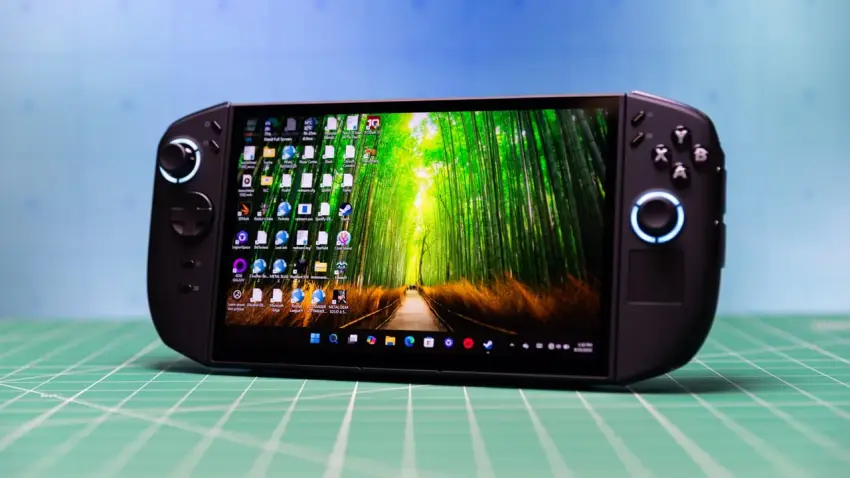
The display is a 8.8-inch QHD+ OLED panel with a high refresh rate, providing a significantly larger and higher-quality screen than either the ASUS ROG Xbox Ally series or the Steam Deck. The device features detachable controllers — similar in concept to the Nintendo Switch — which can be used in handheld mode or removed and used as wireless gamepads. A kickstand allows the device to be used in tabletop mode. A proprietary USB-C accessory connector enables accessories including a charging dock and additional peripherals.
Even at launch, the Legion Go 2 was considered an enthusiast device — expensive by handheld standards but justifiable for buyers who wanted maximum performance and didn't want the compromises of the more affordably priced alternatives. Windows Central's Daniel Rubino, who purchased one at launch, called it 'the best handheld gaming PC of 2025' and said that even when people were paying $650 over MSRP on the secondary market due to shortage, he understood why — 'it's just that good.'
At $2,000: A Different Proposition Entirely
At $1,349.99, the Legion Go 2 Extreme was expensive but defensible. At $1,999.99, it enters a different conversation entirely. For $2,000, a consumer can purchase a powerful gaming laptop with a dedicated GPU that significantly outperforms any integrated graphics chip. For $2,000, a consumer can purchase a PlayStation 5 and an Xbox Series X simultaneously and have money left over for games. For $2,000, a consumer can build a capable gaming desktop PC. The question of whether a handheld gaming PC justifies $2,000 is not merely a question of preference — it is a question of value that most buyers will answer in the negative.
The Outerhaven's Keith Mitchell, who owns both ROG Ally models and both Legion Go variants, put it plainly: 'It's one of the better handhelds, though it already struggled at launch due to its higher price and weight.' The concern about weight — the Legion Go 2 is one of the heavier handheld gaming devices on the market due to its large screen and detachable controllers — was already a frequently cited limitation. At double the price of the Steam Deck OLED and significantly more than the ASUS ROG Xbox Ally X, these limitations become harder to rationalize.
The Cause: A DRAM and NAND Shortage That Shows No Sign of Easing
Lenovo has not officially commented on the reasons for the price increase. But the context is unmistakable, and industry observers are unanimous in their diagnosis: the ongoing shortage of DRAM (the type of RAM used in handheld devices, laptops, and smartphones) and NAND flash storage is the primary driver of price increases across consumer electronics.
Why Is There a DRAM Shortage?
The current DRAM shortage has its roots in a confluence of factors that accelerated through 2025 and into 2026. At the demand side, the rapid scaling of AI infrastructure — particularly the deployment of large language models and AI training systems requiring enormous amounts of high-bandwidth memory — has absorbed a significant portion of global memory production. Major AI hardware customers, including hyperscale cloud providers like Microsoft Azure, Amazon Web Services, and Google Cloud, have dramatically increased their orders for advanced memory types, competing with consumer device manufacturers for the same production capacity.
On the supply side, the transition to more advanced DRAM manufacturing processes — particularly LPDDR5X, the type of RAM used in devices like the Legion Go 2 — involves complex, capital-intensive production lines that cannot be scaled up quickly. A single advanced memory fabrication facility costs several billion dollars and takes years to plan, construct, and bring to full production. The memory manufacturers — primarily Samsung, SK Hynix, and Micron — cannot simply build more factories in response to short-term demand spikes.
The GPU shortage referenced in the original article title adds another dimension: NVIDIA's decision to allocate a greater proportion of its production capacity to data center AI accelerators (primarily the H100, H200, and Blackwell-series chips) rather than consumer graphics cards has both tightened supply of consumer GPUs and signaled the broader shift of semiconductor supply toward AI infrastructure, creating ripple effects across all segments of the consumer electronics supply chain.
What the Shortage Has Already Done to Gaming Hardware Prices
The Legion Go 2 price increase is part of a wave of gaming hardware price hikes that has swept through the industry over the past six months. The pattern is consistent across platform holders, PC manufacturers, and peripheral vendors alike.
| 📊 Gaming Hardware Price Increases — 2025/2026
• PS5 (Standard): $549.99 → $649.99 (+$100, +18%) — March 2026 • PS5 Pro: $749.99 → $899.99 (+$150, +20%) — March 2026 • Xbox consoles: Multiple increases totaling significant amounts — October 2025 (second hike) • Legion Go 2 (16GB): $1,099.99 → $1,499.99 (+$400, +36%) — April 2026 • Legion Go 2 (32GB): $1,349.99 → $1,999.99 (+$650, +48%) — April 2026 • Steam Deck OLED: Sold out in US for weeks — supply only recently restored March 2026 • Gaming laptops/desktops: Hundreds to thousands of dollars more than 18 months ago |
Android Headlines notes that the same shortage affecting the Legion Go 2 is also responsible for SSDs and RAM kits ballooning in price, gaming laptops and desktops costing hundreds to thousands more than they did a year or two ago, and smartphones becoming more expensive across the board. The DRAM shortage is, in other words, not a gaming-specific phenomenon — it is a fundamental constraint on the entire consumer electronics supply chain, and gaming hardware is feeling it with particular acuity because gaming devices tend to use large amounts of fast, expensive memory.
Will Prices Come Down?
Game Rant reports that DDR5 RAM prices in the retail market have started to taper off — but there is currently no indication that rates will drop back to their previous points. The distinction between stabilization and reduction is important: prices may stop rising, but they are unlikely to return to pre-shortage levels in the near term. The structural factors driving the shortage — AI infrastructure investment competing for memory production capacity — show no signs of reversing, and the memory manufacturers have limited incentive to aggressively expand supply in ways that would drive prices back down.
For gaming hardware specifically, the timing is particularly challenging. Handheld gaming PCs — a category that was just beginning to achieve genuine mainstream adoption in 2025 — are being priced back into niche enthusiast territory precisely when they seemed poised for broader market penetration. The concern is that price increases will slow adoption to a trickle just as the category was gaining momentum, potentially stunting the ecosystem development that would drive the next generation of better, cheaper handheld devices.
The Competitive Landscape: Where Does the Legion Go 2 Stand Now?
At its launch prices, the Legion Go 2 faced meaningful competition from the ASUS ROG Xbox Ally X and the Steam Deck OLED, with each device occupying a distinct position in the market. At its new prices, the competitive dynamics shift significantly.
Current Handheld Gaming PC Market Overview
| Device | Current Price | OS | Processor | RAM | Storage | Status |
| Steam Deck OLED (512GB) | $549.99 | SteamOS | AMD Z1 Extreme | 16GB | 512GB | Limited stock |
| Steam Deck OLED (1TB) | $649.99 | SteamOS | AMD Z1 Extreme | 16GB | 1TB | Limited stock |
| ASUS ROG Xbox Ally | $599.99 | Windows 11 | AMD Ryzen Z2 | 16GB | 512GB | In stock |
| ASUS ROG Xbox Ally X | $999.99 | Windows 11 | AMD Ryzen Z2 Extreme | 24GB | 1TB | In stock |
| Lenovo Legion Go S | ~$599-699 | Win/SteamOS | AMD Ryzen Z2 Go | 16GB | 512GB | Available |
| Lenovo Legion Go 2 (16GB) | $1,499.99 | Windows 11 | AMD Ryzen Z2 | 16GB | 512GB | Out of stock |
| Lenovo Legion Go 2 (32GB) | $1,999.99 | Windows 11 | AMD Ryzen Z2 Extreme | 32GB | 1TB | Out of stock |
The ASUS ROG Xbox Ally X: The Accidental Winner
In the current market, the ASUS ROG Xbox Ally X has emerged as what PC Guide calls 'the best option right now' — not because it has gotten better, but because its competitors have gotten more expensive and less available. The ROG Xbox Ally X remains priced at $999.99 — exactly the same as its launch price — and is readily available in stock at major US retailers.
The ROG Ally X is powered by the same AMD Ryzen Z2 Extreme processor as the Legion Go 2's high-end model, with 24GB of LPDDR5X RAM versus the Legion Go 2's 32GB. Performance-wise, the two devices are broadly comparable. The ROG Ally X's display is smaller (7 inches vs. the Legion Go 2's 8.8 inches) and uses LCD rather than OLED technology, and it lacks the Legion Go 2's detachable controllers. But at $1,000 versus $2,000, these trade-offs become significantly easier to accept.
The ROG Ally X's continued availability at its launch price represents a notable competitive advantage — whether by design, better supply chain management, or simply the fortune of having secured component supply agreements before the shortage intensified. ASUS's decision not to raise prices on its Ally line has earned significant goodwill from the gaming community, and several commentators have noted that Lenovo's silent price hike makes the ROG Ally ecosystem look considerably more attractive by comparison.
Steam Deck: The Value Benchmark Under Pressure
Valve's Steam Deck OLED remains the value benchmark for the handheld gaming PC category — at $549.99 and $649.99 for its 512GB and 1TB configurations respectively, it offers performance that is sufficient for a wide range of games at handheld-appropriate settings. However, the Steam Deck is currently facing its own shortage problems: the OLED model sold out completely in the US for several weeks, returning to availability only in March 2026 in limited quantities.
Valve's position is complicated. The company is committed to keeping the Steam Deck accessible — the entire product philosophy of the Steam Deck is democratizing handheld PC gaming — but the shortage of NAND flash storage (which the Steam Deck uses extensively) has disrupted supply. Valve has also reportedly been forced to discontinue the cheaper configurations of the Steam Deck, narrowing the product line and reducing the availability of the most affordable entry points.
The Legion Go S: The Budget Exception
Notably, Lenovo has not yet raised prices on the Legion Go S — the smaller, more affordable sibling of the Legion Go 2. The Go S was designed from the outset as a more mass-market device, using the AMD Ryzen Z2 Go processor rather than the full Z2 or Z2 Extreme, with more modest specifications and a lower price point around $599–699. As of this writing, the Go S remains at its original pricing and is available in stock.
The Go S's immunity to the price hike — for now — may reflect its different component profile: it uses less RAM and lower-performance storage than the Go 2, and may be less affected by the specific shortage driving the Go 2's price increase. Alternatively, Lenovo may have made a deliberate decision to protect its more accessible product line from price increases while accepting that the enthusiast Go 2 market can absorb higher prices. The Outerhaven's editor speculates that the Go S's pricing might eventually be affected as well.
The Console Market: Sony, Microsoft, and Nintendo Under Pressure
The Legion Go 2 price increase does not stand alone — it is part of a wave of gaming hardware price hikes that has affected traditional console makers as well. Understanding the broader context of console pricing helps frame the severity of what is happening to the gaming hardware market.
Sony's PS5 Price Hike
In March 2026 — just weeks before Lenovo's quiet price adjustment — Sony officially raised the prices of both the standard PS5 and the PS5 Pro. The standard PS5 rose from $549.99 to $649.99, a $100 increase of roughly 18%. The PS5 Pro — Sony's higher-performance variant aimed at 4K gaming enthusiasts — jumped from $749.99 to $899.99, a $150 increase of 20%.
Sony's announcement was notable for two reasons: first, the company was explicit about the rationale (supply chain costs, though it did not specify DRAM shortage as the sole cause), and second, the magnitude of the PS5 Pro increase in particular generated significant consumer backlash. A $900 gaming console is a significant investment, particularly for a product in its second major price tier in less than a year.
Microsoft's Xbox Price History
Microsoft has now raised Xbox console prices twice. The most recent increase, in October 2025, was the company's second adjustment of that calendar year. The Xbox Series X and Series S have seen cumulative price increases that reflect the same supply chain pressures affecting all gaming hardware manufacturers. Microsoft has been somewhat more communicative than some competitors about the cost pressures behind its pricing decisions, but the increases themselves are no less impactful to consumers.
Nintendo: Denial Under Pressure
Nintendo occupies the most complex position in the current pricing environment. Rumors emerged in February 2026 that Nintendo was considering raising Switch prices due to the memory shortage — an unusual situation for a company whose console had just launched. Nintendo pushed back against these rumors, denying any impact from 'spiraling memory prices' on its financials. Whether this denial reflects genuine immunity (perhaps through pre-negotiated component supply contracts), a deliberate decision to absorb higher component costs rather than pass them to consumers, or simply a communication strategy that delays an eventual price announcement remains to be seen.
What is clear is that Nintendo is under the same structural pressures as every other consumer electronics manufacturer. Its hardware uses NAND flash storage and DRAM. Its manufacturing partners face the same supply constraints as Samsung's manufacturing partners or Lenovo's. The question is not whether Nintendo faces these pressures, but how it chooses to manage them commercially.
What This Means for the Handheld Gaming PC Category
The Legion Go 2 price increase — and the broader gaming hardware pricing crisis — has significant implications for the handheld gaming PC market, which was widely described as having achieved a tipping point toward mainstream adoption in 2025.
From Mainstream to Niche (Again)
Windows Central's Daniel Rubino captured the sentiment accurately: 'I'm confident that 2025 will be the year handheld gaming PCs finally went mainstream, and it's about time. Too bad that the 2026 RAM shortage and price hikes are likely blunt the adoption of what is otherwise a thriving, nascent market.'
The concern is well-founded. The handheld gaming PC category has always been inherently niche: it requires consumers who are willing to manage a Windows PC environment, who value portability over the superior performance of a desktop or gaming laptop, and who are prepared to pay a significant premium over a traditional console or the Steam Deck for the flexibility of a Windows-based device. At $1,099.99, the Legion Go 2 was already positioned as an enthusiast purchase. At $1,999.99, it becomes a purchase for a vanishingly small segment of the market — one that Keith Mitchell of The Outerhaven describes correctly as 'the niche enthusiast who has the money.'
The Platform Development Problem
The gaming hardware category depends on volume — not just for the economics of individual devices, but for the development of the software ecosystem around those devices. Game developers optimize their titles for specific hardware; accessory manufacturers design products for specific form factors; streaming services and cloud gaming platforms prioritize compatibility with the most popular devices. A handheld gaming PC market that shrinks back to niche status due to pricing will see slower software optimization, fewer accessories, and less third-party support.
This creates a risk of a negative feedback loop: higher prices reduce adoption, reduced adoption shrinks the developer community's incentive to optimize for handheld devices, and fewer optimized titles make the devices less appealing at any price. Breaking this loop requires either prices to return to more accessible levels — which depends on the memory shortage resolving — or for the inherent quality and convenience of handheld gaming PCs to sustain demand even at higher price points. Historical precedent in gaming hardware suggests that sustained premium pricing without compelling exclusive software tends to limit platform growth significantly.
The SteamOS Legion Go 2: A Coming Alternative?
One potential bright spot for price-conscious Legion Go 2 buyers: Lenovo has confirmed plans to release a SteamOS version of the Legion Go 2 in June 2026. SteamOS — the Linux-based operating system developed by Valve — does not require a Windows license, which typically adds approximately $100–150 to the cost of a Windows-based device. The Outerhaven's review noted that the SteamOS version 'should be at least $100 cheaper since it won't include a Windows 11 license.'
However, PC Guide raises a pertinent question: with the recent price increases on the Windows version, will the SteamOS pricing be meaningfully better? If the underlying component costs are driving the price increases, a version that saves only the Windows license fee would still be substantially more expensive than the launch pricing of the Windows version. Buyers hoping the SteamOS edition will represent a return to more accessible pricing should manage their expectations accordingly.
What Should Buyers Do? Practical Guidance for the Current Market
For consumers who were considering purchasing a handheld gaming PC in the current environment, the situation is genuinely difficult. The best devices are either unavailable, dramatically more expensive than they were six months ago, or both. Here is a practical framework for making decisions in this constrained environment.
If You Can Wait: Wait
If you do not have an urgent need for a handheld gaming PC and can delay your purchase, waiting is the most prudent option. DRAM market conditions, while currently unfavorable, have historically been cyclical: periods of shortage and elevated pricing are followed by periods of oversupply and price reduction. Memory manufacturers are expanding capacity, and as AI infrastructure investment normalizes, some relief to the consumer DRAM market is eventually expected.
Beyond the memory situation, the handheld gaming PC product landscape continues to evolve rapidly. New devices from established manufacturers and new entrants are expected throughout 2026 and 2027. The SteamOS Legion Go 2 launches in June. AYANEO has announced devices. Qualcomm is rumored to be entering the handheld gaming space with ARM-based processors optimized for Windows gaming. Waiting allows buyers to benefit from both potential price normalization and the arrival of new hardware options.
If You Must Buy Now: The ROG Xbox Ally X Is the Rational Choice
For buyers who cannot wait and need a capable handheld gaming Windows PC today, the ASUS ROG Xbox Ally X is the most defensible purchase in the current market. At $999.99 — exactly its launch price, with no increases — it delivers performance comparable to the high-end Legion Go 2 at exactly half the current price. Its 24GB of RAM is somewhat less than the Go 2's 32GB, its 7-inch LCD display is smaller and less premium than the Go 2's 8.8-inch OLED, and it lacks detachable controllers, but these trade-offs are minor compared to the $1,000 price difference.
If You Want Maximum Value: The Steam Deck OLED
For buyers whose priority is maximum value for money and who are comfortable with SteamOS rather than Windows, the Steam Deck OLED remains the best purchase in the handheld gaming category. At $549.99–$649.99, it offers excellent gaming performance for titles in Valve's Steam library, a mature and well-supported operating system, and broad community support. Its stock situation has improved since March 2026, though buyers should confirm current availability before planning a purchase.
What to Avoid: Secondary Market Overpaying
The Legion Go 2's combination of premium status and stock shortages has predictably driven secondary market prices even higher than the already-elevated official retail prices. Resist the temptation to pay scalper premiums on platforms like eBay or Facebook Marketplace. Paying $2,500 or more for a device officially listed at $1,999 (itself an inflated price) makes no financial sense in any scenario — especially for a device whose primary competitive advantage over the ROG Ally X is a larger OLED screen and 8GB more RAM.
The Silence of Lenovo: A Missed Communication Opportunity
One of the most striking aspects of the Legion Go 2 price increase is its total absence of communication. Lenovo did not issue a press release, a blog post, a statement to media, or even an update to its product pages explaining the change. Prices simply appeared higher at retailers overnight. This approach — common among hardware manufacturers facing uncomfortable news — is a significant missed opportunity.
Compare Lenovo's silence to Sony's approach with the PS5 price increase in March: while Sony's announcement generated criticism and consumer frustration, it also gave buyers clarity about what was happening and why. Consumers could make informed decisions about whether to purchase before the increase or wait. Lenovo's silent approach gives consumers no such opportunity and no explanation, creating a sense that the company hoped consumers would simply not notice the change.
In the social media era, hoping that a 48% price increase on a prominent gaming device will go unnoticed is not a viable communication strategy. The story broke on social media within hours of the changes appearing on retailer websites, generating significant negative press coverage. A proactive announcement acknowledging the supply chain pressures, explaining the business necessity of the increase, and providing guidance on the company's plans to normalize pricing when supply conditions improve would have been far better received than silent adjustment.
The absence of communication also leaves a vacuum that is filled by speculation and cynicism. Without an official explanation, consumers are left to assume the worst — price gouging, exploitation of strong reviews, or disregard for the community that made the Legion Go 2 a success. Lenovo has an opportunity to address this situation directly, and failing to do so will continue to damage brand perception among a community that had been genuinely enthusiastic about the product.
Conclusion: A Market at an Inflection Point
The Lenovo Legion Go 2 price increase is, in the most direct sense, a story about supply chain economics: DRAM is expensive, NAND is scarce, and manufacturers are passing those costs on to consumers. But it is also a story about a gaming hardware category at a critical inflection point — a moment when handheld gaming PCs seemed finally ready to transcend their niche origins and reach a mainstream audience, only to be pushed back toward exclusivity by pricing pressures beyond any individual manufacturer's control.
The $2,000 price tag on the Legion Go 2's high-end configuration is not just a number — it is a symbol of how far the current hardware market has drifted from the vision of accessible, portable PC gaming that drove the category's initial growth. Valve built the Steam Deck to be a $399 device. The trajectory since then has been one of steady price escalation, driven partly by legitimate hardware improvements and partly by component cost pressures that show no signs of immediate resolution.
For the long-term health of the handheld gaming PC category, the ideal outcome is a resolution of the DRAM shortage that allows prices to normalize and the market to expand. Whether that happens in 2026, 2027, or later depends on factors — AI infrastructure investment, memory production capacity, global semiconductor trade policy — that are largely outside the control of gaming hardware manufacturers and consumers alike.
In the meantime, buyers should spend wisely: the ROG Xbox Ally X represents rational value in a market where rationality is increasingly difficult to find. The Steam Deck remains the benchmark for accessible handheld gaming. And the Legion Go 2, for all its genuine technical excellence, is at $1,999.99 a device that can only be recommended to the most enthusiastic and financially comfortable buyers — which is a shame, because at its original price, it deserved a much wider audience.
Quick Reference: Handheld Gaming PC Market — April 2026
| Device | Price | Value | Availability | Recommendation |
| Steam Deck OLED 1TB | $649.99 | Best value | Limited | Best for SteamOS users |
| ASUS ROG Xbox Ally X | $999.99 | Strong value | In stock | Best Windows buy right now |
| Lenovo Legion Go S | ~$699 | Good value | Available | Budget Windows option |
| Legion Go 2 (16GB) | $1,499.99 | Questionable | Out of stock | Wait for price drop |
| Legion Go 2 (32GB) | $1,999.99 | Poor value | Out of stock | Avoid at current price |
FAQ – Lenovo Legion Go 2 Price Increase 2026
1. Why did the Lenovo Legion Go 2 price increase so drastically?
The price increase is mainly driven by a global shortage of DRAM and NAND flash storage, which has significantly raised production costs for gaming hardware and other electronics.
2. How much did the Legion Go 2 price increase?
The base model increased from $1,099.99 to $1,499.99 (+36%), while the high-end model jumped from $1,349.99 to $1,999.99 (+48%).
3. Did Lenovo officially announce the price increase?
No, Lenovo did not make any official announcement. The new prices appeared quietly on retailer listings without explanation.
4. Is the Legion Go 2 still worth buying at $1,999?
For most users, no. At that price, buyers can get a powerful gaming laptop or desktop PC with significantly better performance.
5. What makes the Legion Go 2 a premium handheld gaming PC?
It features an AMD Ryzen Z2 Extreme processor, up to 32GB RAM, a large 8.8-inch OLED display, detachable controllers, and full Windows support.
6. Are other gaming devices also increasing in price?
Yes, devices like the PlayStation 5, Xbox consoles, and gaming laptops have also seen price increases due to the same hardware shortages.
7. What is causing the global DRAM and NAND shortage?
The shortage is driven by high demand from AI infrastructure, limited manufacturing capacity, and complex production processes for advanced memory.
8. What is the best alternative to the Legion Go 2 right now?
The ASUS ROG Xbox Ally X is considered the best alternative, offering similar performance at around half the price.
9. Is the Steam Deck still a good option in 2026?
Yes, the Steam Deck OLED remains the best value handheld gaming PC, especially for users who prefer SteamOS over Windows.
10. Will Legion Go 2 prices go down in the future?
Prices may stabilize, but a significant drop is unlikely in the short term due to ongoing memory shortages and high demand.
11. Should I buy a handheld gaming PC now or wait?
If possible, it is better to wait until prices stabilize or new devices are released, especially with ongoing market uncertainty.
12. Is Lenovo planning a cheaper version of the Legion Go 2?
Yes, a SteamOS version is expected, which may be slightly cheaper since it does not include a Windows license.
Tinggalkan Balasan