
Jeff Bezos’ $100B AI Plan Will Change Manufacturing Forever
3 minggu ago · Updated 3 minggu ago
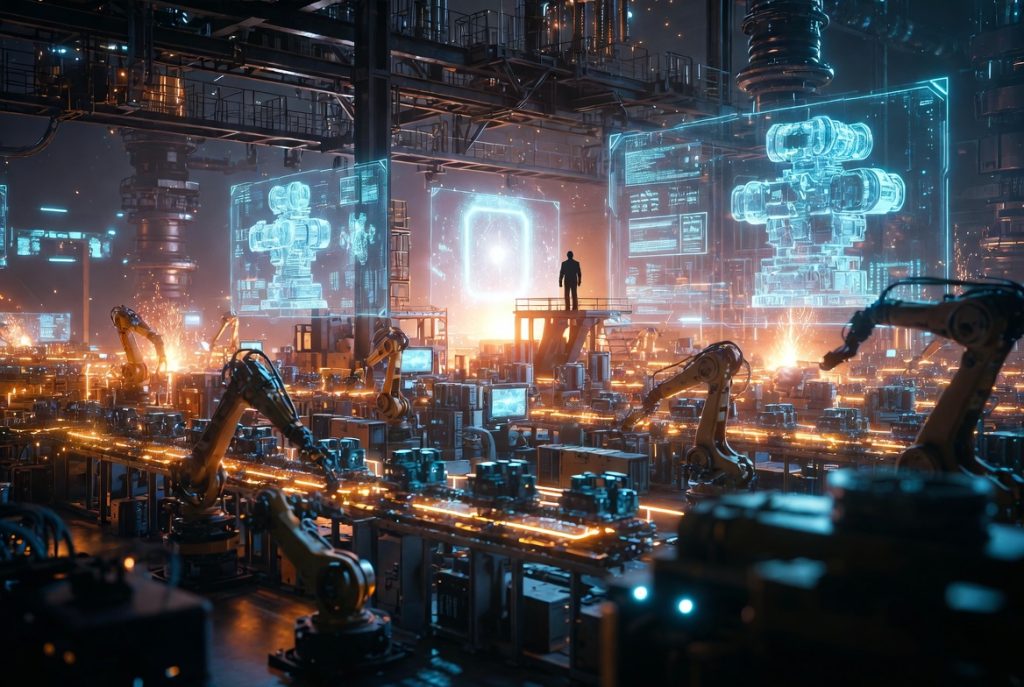
In the spring of 2026, one of the most consequential industrial bets in modern history has quietly taken shape. Jeff Bezos, founder of Amazon and one of the wealthiest individuals ever to walk the earth, is reportedly seeking to raise a staggering $100 billion fund under the banner of Project Prometheus. The goal is audacious: to acquire aging, capital-intensive manufacturing companies across the globe and transform them from within using cutting-edge Artificial Intelligence.
This is not a technology startup story in the conventional sense. It is the story of a collision between two worlds that have long existed in separate orbits — the fast-moving, software-driven universe of Silicon Valley and the slow, gritty, capital-hungry realm of industrial manufacturing. If Bezos succeeds, the impact will reverberate not just in quarterly earnings reports, but in how jet engines are designed, how semiconductors are fabricated, how automobiles roll off assembly lines, and how the physical infrastructure of modern civilization is built and maintained.
This report provides the most comprehensive analysis available of Project Prometheus — its origins, technological foundation, investment structure, the sectors it seeks to disrupt, the global fundraising roadshow, and the formidable challenges that stand in its way. Drawing on the latest reporting from The Wall Street Journal, Bloomberg, Axios, the Financial Times, TechCrunch, and dozens of technical sources, this is a definitive account of the most ambitious industrial transformation plan ever conceived.

Chapter 1: The Man Behind the Bet
1.1 From Seattle’s Garage to the World Stage
To understand the ambition behind Project Prometheus, one must first appreciate the extraordinary arc of Jeff Bezos’ career. Born in Albuquerque, New Mexico in 1964, Bezos studied electrical engineering and computer science at Princeton before spending his early career in finance on Wall Street. In 1994, he left a senior position at hedge fund D.E. Shaw to found Amazon in a Bellevue, Washington garage, betting that the emerging internet could transform retail.
What followed over the next three decades was one of the most remarkable business stories of the modern era. Amazon grew from an online bookstore into the world’s largest e-commerce platform, a dominant cloud computing provider through AWS, a streaming entertainment giant, a global logistics operation, and a pioneer in smart home devices. By the time Bezos stepped down as CEO in July 2021, Amazon was valued at over $1.7 trillion and employed more than 1.3 million people worldwide. The company had fundamentally reshaped how people shop, how businesses store data, and how products reach consumers.
But retirement was never in the cards for Bezos. Following his departure from Amazon’s day-to-day operations, he expanded his involvement in Blue Origin, his commercial rocket company, and deepened his personal investment portfolio across biotech, media, real estate, and climate technology. He also spent considerable time and resources exploring the next frontier of technology. Then, in November 2025, came the announcement that surprised even the most seasoned observers of the technology industry: Bezos was returning to active operational leadership as co-CEO of a new AI company called Project Prometheus.
1.2 A Historic Return to Operations
The significance of Bezos taking an operational role again cannot be overstated. Since leaving Amazon, he had been an investor and board member in various ventures, but had deliberately avoided the day-to-day responsibilities of running a company. His return to co-CEO duties at Project Prometheus — reportedly his own initiative — signals a level of personal conviction in the venture that goes far beyond a passive financial bet.
Those who have worked with Bezos at Amazon describe a leader with an extraordinary capacity for long-term, high-conviction thinking — someone willing to invest billions and wait years for a strategy to mature. It was this same mindset that drove Amazon Web Services from a speculative internal project to the world’s dominant cloud computing platform. Project Prometheus appears to reflect the same pattern: a massive, early investment in an infrastructure-level technology that most of the world has yet to recognize as transformative.
"Jeff Bezos getting back into the trenches is exciting, and it tells you he sees a real opportunity. The huge upfront raise is probably about instant credibility — the only way to recruit the top talent and show this isn’t a small experiment." — Scott Chou, ESO Fund Co-Founder
Chapter 2: What is Project Prometheus?
2.1 Origins and Structure
Project Prometheus is an artificial intelligence startup founded by Jeff Bezos in November 2025. Bezos serves as co-founder and co-CEO alongside Vik Bajaj — a physicist and chemist who previously led moonshot research at Google X, the legendary innovation laboratory behind self-driving cars and Project Loon. Bajaj also co-founded Foresite Labs, a biotech-focused AI incubator, making him one of the rare scientists with deep expertise spanning both physical science and artificial intelligence. The company is headquartered in San Francisco, with satellite offices in London and Zurich.
The company launched with $6.2 billion in initial financing — a figure that dwarfs virtually every Series A round in history by several orders of magnitude. A significant portion of this capital came directly from Bezos himself, a personal statement of conviction. Project Prometheus was valued at approximately $30 billion at launch, according to the Financial Times, making it one of the most highly valued early-stage companies ever created. By December 2025, the company had hired over 120 employees, with elite researchers recruited from OpenAI, Google DeepMind, Meta AI, and Tesla.
2.2 The Talent Roster
Among the most significant hires at Project Prometheus are researchers with direct ties to the foundational work of the modern AI revolution. According to multiple reports, the company has recruited co-authors of the 2017 Google Brain paper "Attention Is All You Need" — the landmark work that introduced the Transformer architecture underpinning virtually every powerful AI system in existence today, from ChatGPT to Gemini to Claude. The presence of these researchers suggests that Prometheus is not building on existing AI tools, but seeking to advance the fundamental science of artificial intelligence in directions specifically optimized for physical-world applications.
Robert Nelsen, co-founder and managing director of ARCH Venture Partners, sits on the Prometheus board and has been an outspoken advocate for the company’s mission. Speaking at a public event in January 2026, Nelsen stated: "Figuring out how to reinvent the physical world is a big challenge. But the pace of innovation in AI right now is truly hard to understate." The appointment of Blue Origin CEO David Limp to the Prometheus board of directors further underscores the deep integration between Bezos’ various industrial and technological ventures.
2.3 The Acquisition of General Agents
One of the first concrete signals of Prometheus’ technical ambitions was the stealth acquisition of General Agents, a startup building agentic AI systems capable of autonomously executing complex digital tasks. The acquisition was revealed through corporate filings examined by WIRED, coming to light shortly after a private dinner in San Francisco hosted by Vik Bajaj and attended by select AI researchers, scientists, and journalists.
General Agents had developed a product called "Ace" — described as a real-time computer pilot capable of taking control of any computer and executing multi-step tasks based on natural language instructions. Demonstration videos showed Ace downloading images, composing messages, and performing sequences of digital actions in under 15 seconds, at speeds that competitors had not yet matched. The acquisition of General Agents gives Prometheus the building blocks for AI agents that can not only simulate the physical world but actively interface with the digital control systems that govern manufacturing equipment, supply chains, and engineering workflows.

Figure 2: Physical AI connects deep learning with real-world systems — factory sensors, supply chains, and aerospace components.
Chapter 3: The Technology — Physical AI Explained
3.1 Beyond Language Models
To grasp the technology at the core of Project Prometheus, it is essential to understand what distinguishes “Physical AI” from the AI systems that have dominated public attention since 2022. The large language models that power ChatGPT, Gemini, and Claude are extraordinarily sophisticated at processing and generating language, code, and structured information. They have been trained on hundreds of billions of words drawn from the accumulated text of human civilization. But they have a fundamental limitation: they exist entirely within the world of symbols, text, and statistical patterns derived from human language.
Physical AI is fundamentally different. It is designed not to understand language about the world, but to understand the world itself — its materials, its mechanics, its thermodynamics, its structural properties under stress, and the complex, interdependent systems that govern how physical things are built and how they break. This requires AI that can learn not from reading about physics, but from observing and interacting with physical systems directly, processing sensor data, and building models of how material reality behaves.
As described in internal documents and by people familiar with the company, Project Prometheus’ technology “generates accurate simulations of how real-world physical systems behave: factory floors, supply chains, machines under stress, aerospace components in operation.” The goal is not to describe manufacturing in words, but to model it with the precision of a physicist.
3.2 Digital Twins: The Core Technology
The central pillar of the Prometheus technology stack is the concept of digital twins — highly accurate, real-time AI simulations of physical systems such as factories, production lines, and individual machines. A digital twin allows engineers and operations managers to run millions of virtual stress tests and optimization scenarios before making any changes in the real world. According to reporting from multiple sources, “if you want to optimize a semiconductor fabrication plant, a Prometheus digital twin can simulate thousands of operational configurations before a single change is made on the actual factory floor.”
Consider the practical implications for aerospace manufacturing. To optimize the production line for a new turbine blade, engineers traditionally require months of physical testing, expensive prototyping, and incremental adjustments. With a sophisticated digital twin, the entire production process can be simulated, tested, and optimized in days. Bottlenecks can be identified. Material inputs can be varied. The downstream effects of any change can be modeled with precision. The result is a dramatic compression of development timelines and a steep reduction in production costs.
Prometheus’ digital twins are reportedly designed to model not just individual machines but entire factories and supply chains as integrated systems. This holistic approach means that the AI can identify optimization opportunities that would be invisible to engineers working on individual subsystems in isolation — the kind of system-wide inefficiencies that have accumulated over decades in legacy manufacturing companies.
3.3 Sensor Fusion and Robotics Control
Alongside digital twins, Project Prometheus is investing heavily in sensor fusion and robotics control systems. Sensor fusion refers to the integration of data from multiple sensor types — accelerometers, thermal sensors, optical sensors, acoustic sensors, and more — to build a rich, real-time picture of what is happening inside a machine or on a production floor. This multi-modal sensor data is what allows AI models to perceive and react to physical variables that traditional software cannot handle.
The challenge of deploying AI in the physical world is often described through the concept of the “reality gap” — the discrepancy between simulated training environments and the unpredictable, noisy, constantly changing reality of actual factory floors. An AI model that performs flawlessly in simulation may fail when deployed in a real factory due to humidity fluctuations, vibration patterns in aging machinery, slight variations in raw material quality, or unexpected human interactions. Addressing the reality gap requires enormous amounts of real-world operational data, which is precisely what the acquisition of legacy manufacturing companies is designed to provide.
3.4 Pre-Production Focus: An Important Distinction
A critical nuance often missed in media coverage of Project Prometheus is that the company’s AI focus is not primarily on automating assembly lines with robots — a vision that conjures images of workers being displaced by machines. Instead, as sources familiar with the company have told Axios and other outlets, Prometheus is focused on “using AI to optimize pre-production machinery and processes, such as prototyping. Innovation tied to inputs and materials, rather than to assembly robots.”
This is a strategically important distinction. The design and prototyping phase of a product can determine up to 80% of its eventual manufacturing cost, meaning that AI-driven improvements in engineering and materials science can have a compounding effect on the entire production chain. By focusing on pre-production optimization rather than assembly-line automation, Prometheus also reduces the political risk associated with job displacement, potentially making it easier to win regulatory approval and community support for its acquisitions.

Figure 3: AI-driven manufacturing optimization focuses on pre-production processes, materials science, and digital twin simulation.
Chapter 4: The $100 Billion Investment Strategy
4.1 A Fund Without Precedent
The most audacious dimension of the Project Prometheus story is not its technology — it is its ambition to raise a $100 billion investment fund. To place this figure in context: SoftBank’s Vision Fund, widely considered the largest and most consequential technology investment vehicle in history, raised approximately $100 billion in 2016 with heavy backing from Saudi Arabia and Abu Dhabi. If Project Prometheus achieves its target, it would create a comparable fund focused exclusively on the industrial transformation of physical manufacturing companies — a sector that has historically been underserved by technology investment capital.
Investor documents obtained by The Wall Street Journal describe the fund as a “manufacturing transformation vehicle.” The structure is elegantly straightforward: identify legacy manufacturing companies that are underperforming due to outdated processes, acquire them at attractive valuations, deploy Prometheus’ AI technology to modernize their operations, and capture the resulting efficiency gains and asset value appreciation. Both the fund and Project Prometheus are reportedly being organized under the same holding company, creating a seamless pipeline from AI development to industrial deployment.

Figure 4: The $100B Manufacturing Transformation Vehicle — a private equity-style rollup powered by Physical AI.
4.2 Target Sectors
Prometheus has identified four primary sectors for acquisition, each chosen for its strategic importance, capital intensity, accumulated operational data, and transformative potential under AI-driven optimization:
Semiconductor Manufacturing
The fabrication of microprocessors and memory chips is among the most complex and capital-intensive manufacturing processes on earth. A single advanced semiconductor fabrication plant can cost $20 billion or more to build and requires thousands of highly specialized process steps to produce working chips. Yield — the percentage of chips on a wafer that function correctly — is a critical metric, and even small improvements translate into billions of dollars of additional revenue. The industry is also experiencing intense geopolitical pressure, with the United States, Europe, and Japan investing massively in domestic chip production to reduce dependence on Taiwan and South Korea.
Aerospace and Defense
The aerospace industry produces some of the most complex engineered systems in existence, from commercial aircraft fuselages to jet engines to satellites and military hardware. It is characterized by very long development cycles, extraordinarily tight safety tolerances, and massive documentation requirements. AI could compress development timelines from years to months, improve materials selection, optimize supply chains, and dramatically enhance quality control throughout the production process. The defense component adds strategic urgency: governments around the world are seeking to modernize their defense industrial bases, and AI-enhanced manufacturing capabilities represent a significant national security asset.
Automotive and Electric Vehicles
The global automotive industry is undergoing its most profound transformation in over a century, driven by the electrification of vehicles and the rise of autonomous driving systems. Legacy automakers are struggling to adapt their manufacturing processes to the requirements of electric vehicles, which have fundamentally different production architectures, battery systems, and software requirements compared to combustion-engine cars. AI-driven manufacturing optimization could help legacy automakers navigate this transition faster and more profitably.
Advanced and Heavy Manufacturing
Beyond these three core sectors, the fund is expected to target a wide range of heavy industrial manufacturers, including chemical producers, precision machining companies, advanced materials producers, and industrial equipment manufacturers. These industries share the characteristics of high capital intensity, large volumes of accumulated operational sensor data, and significant room for efficiency improvement through systematic AI application.
TARGET SECTOR ANALYSIS
| Sector | AI Disruption Potential | Strategic Importance | Key AI Applications |
| Semiconductor / Chips | Very High | Critical — national security | AI yield optimization, fab process control |
| Aerospace & Defense | Extremely High | Vital — precision & safety | Predictive maintenance, digital twin testing |
| Automotive / EV | High | High — EV transition imperative | Assembly line AI, materials R&D |
| Advanced Manufacturing | High | Significant — reshoring push | Supply chain AI, robotic process integration |
4.3 The Global Fundraising Roadshow
To raise $100 billion, Bezos has embarked on an ambitious global fundraising campaign. According to The Wall Street Journal, he has traveled to Singapore and the Middle East in recent months, two of the world’s most significant centers of sovereign wealth. Singapore’s GIC and Temasek, along with the sovereign wealth funds of Saudi Arabia (PIF), the United Arab Emirates (ADIA and Mubadala), and Qatar (QIA), collectively manage trillions of dollars in assets and have expressed strong interest in transformative long-term investments.
The pitch to these investors is compelling. For sovereign wealth funds seeking long-term, inflation-resistant returns in tangible assets, a stake in AI-enhanced manufacturing companies offers a powerful combination of stability and upside. Physical factories, unlike software companies, have real asset values that do not evaporate when market sentiment shifts. And the efficiency gains achievable through AI in manufacturing — yield improvements, energy savings, reduced downtime, accelerated product development — translate directly into cash flows that can be measured and modeled.
JPMorgan Chase has also entered the picture, with preliminary discussions reported about backing the project through its Security and Resiliency Initiative. The involvement of JPMorgan would provide not just capital but access to the bank’s unparalleled network of corporate relationships, M&A advisory capabilities, and global institutional investor connections.
4.4 The Blue Origin Dimension
One intriguing and still-unresolved dimension of the Project Prometheus story is the relationship between the fund and Blue Origin, Bezos’ rocket company. David Limp’s appointment as both Blue Origin CEO and Prometheus board member strongly suggests that the two entities are being integrated into a coherent industrial strategy. Blue Origin manufactures rocket engines, spacecraft, and related hardware to extremely precise specifications using some of the most demanding manufacturing processes in existence.
One compelling scenario is that Blue Origin serves as a cornerstone portfolio company for the fund — a living laboratory where Prometheus’ Physical AI technology is deployed at scale in one of the most demanding manufacturing environments imaginable. Rocket manufacturing requires extraordinary precision, involves extreme materials science challenges, demands absolute quality control, and generates enormous quantities of operational sensor data. If Prometheus can demonstrate its AI capabilities in this context, the validation for the broader fund strategy would be almost irrefutable.
Chapter 5: Market Context and Competitive Landscape
5.1 The Industrial AI Market Opportunity
Project Prometheus is entering a market that is already experiencing explosive growth. The global industrial AI market was valued at approximately $1.1 billion in 2020 and is projected to reach $16.7 billion by 2026, representing a compound annual growth rate exceeding 55%. This growth is being driven by a convergence of factors: rapidly declining costs of computing power, advancing AI model capabilities, increasing availability of industrial sensor data, and mounting competitive pressure on manufacturers to cut costs and shorten innovation cycles.
According to surveys of manufacturing executives, AI-driven predictive maintenance alone can reduce unplanned downtime by up to 50% in industrial settings, while AI-optimized supply chains can reduce inventory carrying costs by 20-30%. AI-assisted engineering design can cut prototype development cycles by as much as 60-70%. These are not marginal improvements — in capital-intensive, low-margin industries, they often represent the difference between profitability and financial distress.
5.2 Geopolitical Tailwinds
Project Prometheus is launching at a moment of intense geopolitical focus on manufacturing capacity and supply chain resilience. The COVID-19 pandemic exposed the fragility of global supply chains, with catastrophic shortages of semiconductors, pharmaceuticals, and other critical goods. In response, the United States enacted the CHIPS and Science Act, committing $52 billion to domestic semiconductor manufacturing, and the Inflation Reduction Act, providing hundreds of billions in incentives for clean energy manufacturing. The European Union launched its European Chips Act and the AI Innovation Package, planning at least 15 AI-optimized industrial facilities across the continent.
These policy tailwinds create a powerful alignment between Prometheus’ investment thesis and the priorities of major governments. A fund that strengthens domestic manufacturing capacity in semiconductors, aerospace, and defense is not merely a financial investment — it is a strategic national asset. This alignment could open the door to public-private partnerships, favorable regulatory treatment, and government contracts that amplify the commercial returns of the fund.
5.3 Competitive Landscape
Bezos is not alone in recognizing the opportunity at the intersection of AI and physical manufacturing. Siemens has invested heavily in its Xcelerator platform, offering AI-powered digital twin technology to manufacturers globally. Nvidia has expanded into industrial AI through its Omniverse digital twin platform, powered by its market-dominant GPU hardware. General Electric’s Predix platform has pursued industrial AI with mixed results. The automotive transformation has attracted specialized AI companies targeting vehicle design and production optimization.
Travis Kalanick, the former CEO of Uber, has publicly stated that his venture firm has rebranded specifically to focus on transforming manufacturing industries with AI — a direct parallel to the Prometheus thesis. Against this competitive backdrop, Prometheus’ advantages remain significant: the combination of foundational AI research capability, unprecedented capital scale, Bezos’ proven platform-building track record, and a clear vertically integrated strategy from AI development to industrial deployment creates a competitive moat that will be difficult for any existing player to replicate.
Chapter 6: Risks, Challenges, and Ethical Dimensions
6.1 The Inherent Complexity of Manufacturing
The most significant risk facing Project Prometheus is one that no amount of capital or AI capability can fully eliminate: the inherent complexity and unpredictability of physical manufacturing. Software companies can iterate rapidly, pushing updates and bug fixes to millions of users at near-zero marginal cost. Physical manufacturing requires massive, largely irreversible capital investments; involves supply chains spanning dozens of countries; employs hundreds of thousands of workers with highly specialized skills; and must meet safety standards that leave no room for the “move fast and break things” ethos of Silicon Valley.
History offers cautionary tales of technology companies that entered traditional industries with transformative ambitions and found themselves humbled by physical-world complexity. Bezos himself has experienced this through Blue Origin, which has persistently lagged behind Elon Musk’s SpaceX despite enormous investment. The semiconductor industry, in particular, has resisted the productivity improvements promised by every generation of design automation tools for decades. Manufacturing is, if anything, more complex than rocket-building.
6.2 Workforce and Social Responsibility
Even though Prometheus’ AI focus is reportedly on pre-production optimization rather than assembly automation, the systematic application of AI to manufacturing processes will inevitably reshape workforce requirements. The World Economic Forum’s Future of Jobs report has projected that AI and automation could displace 85 million jobs globally through the mid-2020s while creating 97 million new roles — a net positive on paper, but one requiring massive investment in worker retraining and a careful consideration of who bears the transitional costs.
For a fund acquiring legacy manufacturing companies — often in regions where manufacturing represents the primary economic driver and source of middle-class employment — the social responsibility dimension of workforce decisions will be consequential. How Prometheus handles this in its portfolio companies will have profound implications not only for the affected workers but for the political and regulatory environment in which the fund seeks to operate.
6.3 Regulatory and Geopolitical Risks
A fund of this scale and scope, operating across defense, semiconductors, and aerospace, will attract intense regulatory scrutiny. In the United States, acquisitions of defense-related manufacturers require review by the Committee on Foreign Investment in the United States (CFIUS). If the fund’s capital base includes significant contributions from Middle Eastern sovereign wealth funds, the political sensitivity of such reviews will be substantially elevated, particularly given the ongoing importance of these sectors to U.S. national security.
The EU AI Act, which began enforcement in 2024, imposes strict requirements on AI systems deployed in high-risk applications, including manufacturing processes that affect worker safety. Compliance with this and similar regulatory frameworks across multiple jurisdictions will add significant cost and complexity to Prometheus’ European operations. The fund will need world-class legal, compliance, and government relations capabilities in every market where it operates.
Chapter 7: The Bigger Picture — What This Means for the Future
7.1 A New Model for AI Value Creation
For the first several years of the AI boom, the dominant model of AI value creation was pure software: building foundation models and charging for access through subscriptions or APIs. This model has created extraordinary value for companies like OpenAI, Anthropic, and Google DeepMind, but it also has inherent limitations in terms of the types and scale of value it can ultimately generate. Software companies, however valuable, are competing for a share of existing economic activity. They do not, by themselves, build ships, fabricate chips, or manufacture aircraft engines.
Project Prometheus represents a fundamentally different thesis: that the greatest and most durable value from AI will come from its integration with physical assets and industrial processes. By acquiring manufacturing companies and deploying AI to transform their operations, Prometheus seeks to capture value through the appreciation of tangible assets and the operational cash flows of transformed businesses — the kind of value creation that is anchored in the physical economy and resistant to the volatility of software market valuations.
7.2 Reshoring and National Industrial Power
One of the most politically significant potential outcomes of Project Prometheus is its capacity to accelerate the reshoring of critical manufacturing to the United States and allied nations. If AI can dramatically reduce the labor cost advantages of low-wage manufacturing locations — by automating the processes that currently require large workforces of assembly workers — it could fundamentally alter the economics of global manufacturing geography. A chip factory enhanced by Prometheus AI in Ohio or Arizona may become more competitive than a human-operated facility in Southeast Asia.
This prospect is not merely commercial; it is a matter of national security and economic sovereignty. The dependence of Western nations on foreign manufacturers for semiconductors, advanced electronics, and critical components has been identified by successive administrations as a strategic vulnerability. Project Prometheus, if successful, could help address this vulnerability in a way that government subsidies alone cannot achieve — by making American and allied manufacturing genuinely more competitive through technological transformation rather than just financially supported through tax incentives.
7.3 The 2030 Vision
Looking ahead, industry analysts project that by 2030, more than 70% of manufacturing processes will incorporate AI optimization at some level. The manufacturers that have successfully deployed AI at scale will enjoy substantial cost and quality advantages over those that have not, creating a powerful competitive flywheel effect. First movers will accumulate more operational data, which enables better AI models, which drive further efficiency gains, which generate resources for continued investment — a cycle that will be very difficult for laggards to break.
The semiconductor sector illustrates the potential stakes most clearly. Even a 5-10% improvement in chip yields at a major fabrication plant, achieved through AI-driven process optimization, would represent billions of dollars of annual additional revenue. Extrapolate that across the aerospace, defense, and automotive industries, and the aggregate economic impact becomes almost incalculable. The world Bezos appears to be envisioning — where AI is as fundamental to manufacturing as electricity is today — may be closer than most industry observers currently appreciate.
"The era of pure software play is evolving. If Jeff Bezos succeeds, Project Prometheus will set a new blueprint for how capital and technology intersect — proving that the most lucrative application of intelligence is not in the virtual world, but in the world we touch, build, and inhabit."
Project Prometheus: Key Milestones
A chronological overview of the most significant developments in the evolution of Project Prometheus from its founding in November 2025 through March 2026.
| Date | Milestone | Details |
| Nov 2025 | Project Prometheus Founded | Jeff Bezos launches PP with $6.2B in funding. He takes co-CEO role — his first operational position since leaving Amazon in 2021. Co-founder Vik Bajaj joins from Google X & Verily. |
| Nov 2025 | General Agents Acquired | Prometheus secretly acquires General Agents, maker of the "Ace" agentic AI platform, capable of executing complex multi-step digital tasks in real time. |
| Dec 2025 | 120+ Researchers Hired | Elite talent recruited from OpenAI, DeepMind, Google, Meta and Tesla. Authors of "Attention Is All You Need" join as founding advisors. |
| Dec 2025 | Blue Origin Board Link | David Limp, CEO of Blue Origin, joins the Project Prometheus Board of Directors, signaling deep integration with Bezos’ industrial portfolio. |
| Feb 2026 | FT Fundraising Report | Financial Times first reports that Prometheus is raising "tens of billions of dollars" to acquire and transform businesses disrupted by AI. |
| Mar 2026 | $100B Fund Revealed | WSJ reports Bezos is targeting $100B for a Manufacturing Transformation Vehicle. Fundraising roadshow covers Singapore and Middle East. |
| Mar 2026 | JPMorgan Enters Talks | JPMorgan Chase joins preliminary discussions to back the project through its Security and Resiliency Initiative. |
Conclusion: The Most Audacious Bet in Modern Industry
Project Prometheus is, at its core, a bet — one of the most audacious bets in modern industrial history. It is a bet that AI has matured to the point where it can be systematically deployed not just in software applications but in the dirty, complex, and unpredictable world of physical manufacturing. It is a bet that the legacy manufacturing sector is so deeply ripe for transformation that a technology-first acquirer can generate extraordinary returns by applying AI at industrial scale. And it is, ultimately, a bet on Jeff Bezos himself: that a man who built the world’s most versatile e-commerce and cloud computing empire can do the same thing for the physical economy.
The skeptics have legitimate points. Manufacturing is profoundly hard. Physical AI, however promising, remains in its early stages. The reality gap between simulation and the factory floor is real and difficult to close. The regulatory environment for defense and semiconductor acquisitions is complex and politically sensitive. And the sheer scale of capital being deployed means that even small execution errors could have enormous financial consequences.
But the optimists’ case is also compelling. The combination of foundational AI research capability, unprecedented capital, a clear vertically-integrated strategy, and one of the most successful builders in the history of American business is genuinely unprecedented. The geopolitical environment is creating powerful tailwinds. The technology, while imperfect today, is advancing at an extraordinary pace. And the manufacturing sector — representing trillions of dollars of economic activity worldwide — has been dramatically underserved by technology investment for decades.
Whether Project Prometheus fulfills its extraordinary promise or becomes a cautionary tale about the limits of Silicon Valley ambition when confronted with the physical world, it will shape the landscape of both AI development and industrial manufacturing for decades to come. The factories of tomorrow are being designed today — and if Jeff Bezos has anything to say about it, they will be animated not just by steel and electricity, but by intelligence.
FAQ – Project Prometheus (Jeff Bezos’ $100B AI Manufacturing Bet)
1. What is Project Prometheus?
Project Prometheus is an AI-driven industrial initiative founded by Jeff Bezos under **Amazon’s broader innovation ecosystem, aimed at transforming global manufacturing using advanced Artificial Intelligence.
2. How much funding is involved?
Bezos is reportedly targeting a massive $100 billion investment fund, making it one of the largest industrial-tech bets in history.
3. What is the main goal of Project Prometheus?
The goal is to acquire underperforming manufacturing companies and modernize them using AI to improve efficiency, reduce costs, and increase output.
4. What is “Physical AI”?
Physical AI refers to AI systems designed to understand and optimize real-world systems, including machines, materials, factories, and supply chains—not just text or software.
5. How is this different from AI like ChatGPT?
Tools like ChatGPT focus on language and digital tasks, while Prometheus focuses on real-world industrial processes and physical systems.
6. What are digital twins?
Digital twins are virtual replicas of factories or machines that allow engineers to simulate and optimize processes before applying changes in real life.
7. Which industries will be affected?
Key sectors include:
- Semiconductor manufacturing
- Aerospace and defense
- Automotive and electric vehicles
- Heavy and advanced manufacturing
8. Why is semiconductor manufacturing a target?
Because even small improvements in chip production efficiency can generate billions in additional revenue, making it highly valuable for AI optimization.
9. What role does Blue Origin play?
Blue Origin, Bezos’ space company, may act as a testing ground for AI-driven manufacturing, especially in high-precision aerospace production.
10. What is the investment strategy?
The plan is similar to private equity:
- Buy struggling industrial companies
- Apply AI technology
- Improve operations
- Increase company value
11. Who are the key partners or investors?
Potential investors include:
- Sovereign wealth funds (Middle East, Singapore)
- Major financial institutions like JPMorgan Chase
12. Why is this happening now?
Because:
- AI technology has matured
- Manufacturing needs modernization
- Governments want stronger domestic production
13. What is the “reality gap” in AI?
It’s the difference between AI simulations and real-world performance, where unpredictable factors can affect results.
14. Will this replace human workers?
Not entirely. The focus is on optimizing processes, especially in design and prototyping, rather than fully replacing workers.
15. What are the biggest risks?
- Complexity of manufacturing
- High capital requirements
- Regulatory challenges
- AI performance limitations in real environments
16. How could this impact global supply chains?
It could make manufacturing faster, cheaper, and more localized, reducing dependence on global supply chains.
17. Is this connected to geopolitical strategy?
Yes. Improving domestic manufacturing is critical for economic security and national defense.
18. Who are the main competitors?
Major players include:
- NVIDIA (Omniverse, industrial AI)
- Siemens (digital twins)
- Other AI and industrial tech companies
19. What makes this project unique?
The combination of:
- Massive capital ($100B)
- Advanced AI research
- Direct ownership of factories
- Bezos’ long-term strategy
20. What is the long-term vision?
To make AI as essential to manufacturing as electricity, transforming how the physical world is built.
Tinggalkan Balasan