The Thermal Threshold of the Feline: A Clinical Investigation Into Hypothermia, Metabolic Demands, and Winterization Strategies for Domestic and Community Cats
2 months ago
As the descendants of the African wildcat (Felis lybica), the domestic cat carries an evolutionary blueprint optimized for warm, arid desert ecosystems. This ancestral heritage heavily influences modern feline physiology, dictating everything from their highly efficient renal water-conservation mechanisms to their elevated baseline metabolic parameters.
While centuries of geographical dispersion have forced the domestic feline to adapt to varied climates across the globe, their fundamental homeostatic boundaries remain tightly linked to their desert origins.
┌───────────────────────────────────────────────────────────────────────────┐
│                    Feline Homeostatic Thermal Range                       │
├───────────────────────────────────────────────────────────────────────────┤
│  Normal Feline Core Temp: 100.5°F – 102.5°F                               │
│                                            │                              │
│  Hypothermia Vulnerability Window: < 99.0°F ◄──────────────────────────────┘
└───────────────────────────────────────────────────────────────────────────┘
A common misconception persists that a cat’s fur coat provides an impenetrable shield against extreme environmental conditions. In reality, the domestic feline is highly sensitive to ambient temperature drops.
When exposed to sustained cold, their physiological defenses can quickly become overwhelmed, leaving them vulnerable to local tissue frostbite and life-threatening systemic hypothermia.
This comprehensive, clinically driven masterclass explores the exact physics of feline thermoregulation, establishes critical environmental safety limits, details the warning signs of cold stress, and outlines advanced protection strategies for both domestic companion cats and community/feral populations.
The Physiology of Feline Thermoregulation vs. Human Metrics
To properly evaluate environmental risks for cats, we must first examine the specific numbers that govern feline body temperature. The normal, healthy core body temperature of an adult domestic cat spans a narrow, elevated range:
This baseline is significantly higher than the standard human core temperature range of 97°F to 99°F. Because cats maintain a higher metabolic set point, they require more ambient heat to maintain homeostasis without expending extra internal energy.
When a cat's core internal body temperature drops below 99.0°F, their metabolic processes slow down significantly, marking the clinical onset of systemic hypothermia.
               [ Comparative Ambient Comfort Zones ]
                                 │
     ┌───────────────────────────┴───────────────────────────┐
     ▼                                                       ▼
[ Human Thermal Comfort ]                               [ Feline Thermal Comfort ]
└── 65°F – 72°F Range                                   └── 70°F – 80°F Range
Inside the home, temperatures that feel comfortable to humans (between 65°F and 72°F) are often on the lower end of comfort for a cat. Felines naturally prefer ambient indoor environments stabilized between 70°F and 80°F.
When ambient indoor temperatures drop below 60°F, cats must actively change their behavior to conserve body heat, often seeking out warm microclimates like running appliances, sunny window ledges, central heating vents, or thick blankets.
Defining the Critical Limit How Cold Is Too Cold?
In veterinary critical care, the primary environmental threshold for feline safety is clearly defined: 45°F (7.2°C) represents the critical transition point below which cats face a sharp increase in health risks.
[ Ambient Air Drops Below 45°F ] ──► Systemic Vasoconstriction ──► Ischemic Frostbite Risk
When ambient air temperatures drop below 45°F, a cat’s natural insulation can no longer completely prevent heat from escaping their core. The body responds with systemic vasoconstriction, narrowing peripheral blood vessels to pull warm blood away from the skin and extremities and redirect it toward vital internal organs.
While this mechanism protects the heart and liver, it leaves peripheral areas like the paws, tail tip, and delicate ear margins vulnerable to freezing, cell damage, and ischemic frostbite.
┌───────────────────────────────────────────────────────────────────────────┐
│                    Environmental Risk Acceleration Factors               │
├───────────────────────────────────────────────────────────────────────────┤
│  • Ambient Wetness / Rain ──► Destroys insulating undercoat air pockets.  │
│  • High Wind Velocity    ──► Accelerates convective heat loss from skin.  │
│  • Convective Air Flow   ──► Rapidly pulls warm boundary layer away.      │
└───────────────────────────────────────────────────────────────────────────┘
The 45°F safety threshold assumes dry, calm conditions. If a cat is exposed to rain, snow, or high winds, this safety window changes dramatically. Wetness maps straight to increased danger: when water saturates a cat's fur, it collapses the tiny insulating air pockets trapped within their undercoat, destroying its ability to retain heat.
Convective airflow from cold winds speeds up this heat loss by continuously stripping away the thin layer of warm air warmed by the cat's skin. Under wet or windy conditions, severe hypothermia can easily set in at ambient temperatures well above 50°F.
The Phenotypic and Demographic Matrix of Cold Tolerance
The 45°F threshold serves as a general baseline for healthy adult cats, but individual cold tolerance varies significantly based on age, breed, body composition, and overall health.
                      [ Feline Cold Vulnerability Factors ]
                                        │
         ┌──────────────────────────────┼──────────────────────────────┐
         ▼                              ▼                              ▼
  [ Coat Architecture ]          [ Life-Stage Impacts ]          [ Metabolic Impairments ]
  ├── Sphynx: Zero insulation   ├── Kittens: Poor fat layers   ├── CKD / Arthritis: Weakened
  └── Siberian: Double coat dense└── Seniors: Muscle wasting    └── Endocrine Failure: Low heat
1. Coat Architecture and Genetic Variations
-
Hairless Breeds (Sphynx, Peterbald): These breeds possess zero natural fur insulation, making them entirely incapable of tolerating cold weather. They require temperature-controlled indoor environments year-round and may need specialized pet sweaters during seasonal shifts.
-
Short-Haired, Single-Coated Breeds (Siamese, Oriental Shorthair): These cats have thin coats and lean bodies with minimal body fat, leaving them poorly insulated and highly sensitive to cold stress.
-
Heavy, Double-Coated Breeds (Maine Coon, Siberian, Norwegian Forest Cat): These breeds are genetically optimized for sub-freezing northern climates. They feature water-repellent guard hairs over a dense, insulating undercoat, along with heavily tufted paws that act as natural snowshoes to reduce heat loss through ground contact.
2. Life-Stage Vulnerabilities
-
Pediatric Patients (Kittens): Young kittens have a high surface-area-to-body-mass ratio, meaning they lose body heat much faster than adult cats. They also lack insulating subcutaneous fat layers and have underdeveloped shivering responses, leaving them highly vulnerable to hypothermia and cold-induced low blood sugar (hypoglycemia).
-
Geriatric Patients (Senior Cats): Older cats frequently suffer from age-related muscle wasting (sarcopenia) and thinning coats, which reduces their ability to generate and retain body heat.
3. Metabolic and Underlying Health Impairments
Cats struggling with chronic diseases—such as Chronic Kidney Disease (CKD), diabetes, osteoarthritis, or heart disease—cannot allocate sufficient metabolic energy to maintain their body temperature in cold conditions.
Arthritic cats face double the strain: cold temperatures can cause joint capsules to stiffen and contract, significantly increasing chronic pain and reducing the cat's mobility, making it harder for them to move around to seek out heat sources.
Clinical Progression — Recognizing the Stages of Cold Stress
When a cat is exposed to cold conditions beyond their biological limits, they progress through a predictable series of physiological stages. Recognizing these signs early is vital for preventing permanent injury or death.
                     [ The Hypothermia Progression Arc ]
                                     │
       ┌─────────────────────────────┼─────────────────────────────┐
       ▼                             ▼                             ▼
 [ 1. Early Heat-Seeking ]     [ 2. Mild/Moderate Strain ]   [ 3. Critical Collapse ]
 ├── Shivering reflexes engage ├── Lethargic muscle slowdown  ├── Dilated, unresponsive pupils
 └── Extremities turn cold     └── Shallow breathing metrics └── Complete heart failure risk
Stage 1: The Initial Compensatory Stage (Mild Cold Stress)
During the initial phase of cold exposure, the cat's body activates immediate behavioral and physical defense mechanisms:
-
Heat-Seeking Behavior: The cat will curl tightly into a ball to protect their abdomen and reduce exposed surface area, or try to burrow deep under blankets or behind heating units.
-
Peripheral Vasoconstriction: The paws, tail tip, and ear margins become noticeably cold to the touch as blood is redirected to the body core.
-
Pilomotor Activation: The nervous system causes the fur to stand on end (piloerection) in an attempt to thicken the insulating layer of air trapped within the coat.
-
Involuntary Shivering: Fast, involuntary muscle contractions begin, generating internal heat by burning stored glycogen.
Stage 2: The Moderate Hypothermic Phase
As the core body temperature drops between 90°F and 95°F, involuntary shivering often stops because the body has exhausted its muscle glycogen reserves. Clinical signs then shift from active defense to depression:
-
Systemic Lethargy and Muscle Rigidity: Mental processing slows down, leaving the cat depressed, unresponsive, or clumsy due to stiffening muscle fibers.
-
Cardiovascular and Respiratory Slowdown: The heart rate slows down (bradycardia), and breathing becomes shallow and infrequent.
-
Hypoverbal State: The cat stops crying or vocalizing to preserve their remaining energy.
Stage 3: Severe Hypothermic Collapse (Critical Emergency)
When the core temperature drops below 90°F, the cat enters a life-threatening clinical crisis:
-
Mydriasis (Dilated Pupils): The pupils become fixed and widely dilated, responding poorly or not at all to light.
-
Stupor and Coma: The cat loses consciousness and becomes completely unresponsive to physical touch or sound.
-
Arrhythmias and Cardiac Arrest: The heart's electrical pathways become highly unstable, frequently leading to fatal irregular rhythms and complete circulatory collapse.
Clinical Stabilization Protocols — Safe Rewarming Techniques
If you find a cat showing signs of severe cold stress or hypothermia, you must take immediate action while arranging urgent veterinary transport. Rewarming an animal must be done carefully; raising their temperature too quickly or using incorrect methods can cause life-threatening complications.
[ Hypothermic Patient Admission ] ──► Passive External Wrap ──► Active Controlled Heat ──► Vet Core Monitoring
1. Passive External Rewarming (For Mild Cases)
For cats showing mild cold stress (fully conscious, shivering, with a core temperature above 96°F), use passive rewarming techniques. Wrap the cat snugly in dry, pre-warmed towels or fleece blankets. This layer traps the cat's own body heat, allowing their temperature to rise naturally at a safe, controlled pace.
2. Active External Rewarming (For Moderate Cases)
For cats whose core temperature has dropped below 95°F, passive wrapping alone is not enough. You must introduce external heat sources safely:
┌───────────────────────────────────────────────────────────────────────────┐
│                    Active External Rewarming Protocols                    │
├───────────────────────────────────────────────────────────────────────────┤
│  • Safe Hot Water Bottles  ──► Wrap bottles in towels; never touch skin.  │
│  • Monitored Heating Pads  ──► Set to low; do not leave unattended.       │
│  • Targeted Core Placement ──► Focus heat on axillae, groin, and chest.   │
└───────────────────────────────────────────────────────────────────────────┘
-
Insulated Water Bottles: Fill bottles with hot water, wrap them securely in protective towels, and place them alongside the cat. Never allow a hot water bottle or heating pad to touch an anemic or hypothermic cat's skin directly. Because cold vasoconstriction reduces blood flow to the skin, the tissue cannot dissipate heat normally, which can cause severe thermal burns even at moderate temperatures.
-
Targeted Heat Placement: Focus your heat sources on the cat's core areas—the armpits (axillae), groin, and chest. Avoid heating the paws or tail first; warming the extremities prematurely can dilate peripheral blood vessels, causing cold, stagnant blood from the paws to rush back to the core all at once, which can drop the core temperature further and stall the heart.
3. Advanced Active Internal Rewarming (Clinical Veterinary Care)
For severe, comatose cases (core temperature below 90°F), external heat sources are insufficient and can cause dangerous drops in blood pressure. Veterinary hospitals use advanced internal rewarming techniques under strict monitoring:
[ Core Temperature Below 90°F ] ──► Warm IV Fluid Therapy (101°F-103°F) ──► Internal Organ Stabilization
-
Warm Intravenous Fluid Therapy: Technicians administer sterile, balanced electrolyte fluids warmed precisely between 101°F and 103°F through an IV line to warm the bloodstream directly from the inside out.
-
Humidified Core Oxygen Therapy: The veterinary team delivers warmed, humidified oxygen through an incubation circuit, raising core temperatures while supporting respiration and protecting vital organs.
Winter Field Engineering — Community and Feral Cat Protection
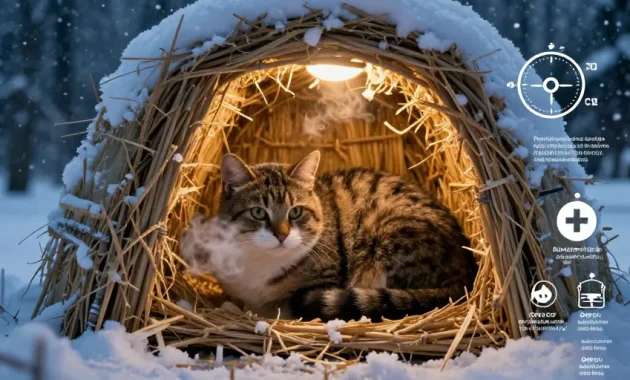
Feral and community cats live outdoors year-round. While they are often highly resilient, harsh winter conditions can cut their life expectancy short through frostbite, illness, or starvation. Because these cats are afraid of humans and cannot be brought indoors, you can help them survive freezing weather by setting up insulated outdoor shelters and feeding stations.
                 [ The Ultimate Feline Winter Shelter ]
                                   │
       ┌───────────────────────────┴───────────────────────────┐
       ▼                                                       ▼
 [ Exterior Shell Setup ]                                [ Interior Insulation Core ]
 ├── Rugged heavy plastic tote                           ├── Loose, packed agricultural straw
 └── Small 6-inch door tunnel                            └── Avoid blankets / shredded paper
1. Designing an Insulated Winter Shelter
An effective outdoor cat shelter can be built easily using a large, heavy-duty plastic storage tote. Follow these specific construction rules to ensure optimal warmth and safety:
-
Strict Sizing Limits: The shelter should be compact, roughly 24 to 36 inches wide. If the box is too large, the cat's body heat will dissipate into the empty air space rather than warming the shelter. A smaller space allows the cat's natural body heat to warm the interior efficiently.
-
Weatherproof Entry Tunnels: Cut a single entry hole exactly 6 inches in diameter into the side of the tote, a few inches above ground level to prevent flooding from melting snow. A 6-inch opening is just large enough for a cat to enter but small enough to keep out large predators like coyotes or raccoons, while blocking cold wind gusts.
-
Using Raw Straw Insulation: Fill the bottom of the shelter with loose agricultural straw. Never use towels, blankets, hay, or shredded paper inside an outdoor shelter.
┌───────────────────────────────────────────────────────────────────────────┐
│                    The Straw vs. Blanket Moisture Rule                    │
├───────────────────────────────────────────────────────────────────────────┤
│  • Clean Agricultural Straw ──► Repels ambient water; keeps air flowing.  │
│  • Cotton Towels / Blankets ──► Absorbs air moisture; freezes solid.       │
└───────────────────────────────────────────────────────────────────────────┘
Blankets and towels are made of absorbent cotton materials that pull moisture from the air and from the cat’s breath. This moisture quickly becomes trapped in the fabric and freezes solid, turning the blanket into an ice block that strips heat away from the cat. Straw features a hollow shaft structure that naturally repels water, allowing cats to burrow inside to utilize their own body heat safely.
2. High-Calorie Winter Feeding Protocols
To maintain their normal body temperature during cold weather, outdoor cats must burn calories at a significantly higher rate. You can help them meet this increased demand with targeted feeding strategies:
Cold Air Exposure ──► High Daily Calorie Burn ──► Increased Dry Kibble Portions + Warmed Water Access
-
Increase Food Portions: Increase daily food portions by 15% to 20% during the winter months, focusing on high-fat, high-protein dry kibble to help cats maintain their energy reserves.
-
Prevent Water Freezing: Wet canned food can freeze solid within an hour in sub-freezing temperatures. Stick to dry kibble for outdoor feeding stations, and place water bowls inside insulated enclosures. Use thick, heavy plastic water bowls rather than stainless steel, as steel bowls pull heat away from water much faster, causing it to freeze rapidly.
Technical Performance Synthesis: Feline Winter Logistics Matrix
To help veterinary technicians, shelter managers, and pet owners quickly compare and evaluate risks, this matrix breaks down the clinical markers, risks, and safety steps for cats across different temperature ranges:
Seasonal Safety Checklist for Cat Owners
Before freezing winter weather arrives, complete this comprehensive safety checklist to ensure your home and surrounding environment are safe for your cats:
-
[ ] Lock Indoor Thermostats: Program your home heating system to stay consistently above 60°F, even when you are away from the house.
-
[ ] Thump Your Car Hood: Outdoor and community cats often climb up into car engine bays to rest against warm, recently turned-off engines. Always slap or thump your car hood firmly before starting the ignition to scare away any hidden cats, preventing severe or fatal fan belt injuries.
-
[ ] Switch to Non-Toxic Antifreeze: Standard automotive antifreeze contains ethylene glycol, a sweet-tasting chemical that is highly attractive to cats but causes fatal kidney failure if even a tiny amount is licked off their paws. Switch your vehicle to a propylene glycol-based antifreeze, which is significantly less toxic to pets.
-
[ ] Monitor Heated Bed Connections: If you use electric pet heating pads or blankets, inspect the cords for chew marks and verify they feature automated safety shut-off switches. Never leave plugged-in heating pads unattended when you leave the house.
-
[ ] Isolate Radiator Radiations: Place protective screens or covers over exposed steam pipes or wood stoves to prevent cats from suffering accidental skin burns when trying to sit close to the heat.
-
[ ] Scale Daily Calorie Portions: Talk to your vet about adjusting your cat's food portions during cold spells, especially if you care for active outdoor community cats that burn extra energy to stay warm.
Summary: Proactive Management of Environmental Risks
Understanding how cold weather affects cats requires looking past common myths and focusing on clear physiological facts. While community cats show incredible resilience when adapting to outdoor life, no cat is immune to the dangers of freezing temperatures. When ambient air temperatures drop below 45°F, cats face real health risks that require targeted protection, cozy bedding options, and appropriate calorie adjustments.
┌───────────────────────────────────────────────────────────────────────────┐
│                    The Winter Protection Equation                         │
├───────────────────────────────────────────────────────────────────────────┐
│  Secure Indoor Microclimates + Insulated Straw Shelters                   │
│                        = Complete Safety Against Extreme Hypothermic Dips │
└───────────────────────────────────────────────────────────────────────────┘
By keeping companion cats safely indoors during cold snaps, checking your vehicle engine bays before driving, and setting up insulated, straw-filled storage totes for neighborhood community cats, you can easily minimize winter hazards. Taking these practical steps ensures that the cats in your care stay warm, safe, and healthy throughout the harshest winter months.
Would you like to explore how to design an automated, low-voltage heated outdoor feeding station that prevents wet cat food and water bowls from freezing during deep winter cold spells?